No items found.
Salesforce
Jan 30, 2024

Retail brands using Agentforce report 60-90% support deflection and higher cart values. Here are 5 ways it drives revenue and loyalty without adding headcount.
.jpg)
Key Takeaways
Retail margins are shrinking while customer expectations keep climbing. Shoppers want instant answers at midnight, painless returns on Sunday, and product recommendations that actually match what they're looking for. Most retail teams are stuck handling the same repetitive questions thousands of times a day while the interactions that actually build loyalty and drive revenue sit in a growing queue.
The math doesn't work anymore. Hiring more support staff to answer "where is my order?" for the hundredth time today doesn't generate revenue. It just keeps the lights on. And during peak season, the hiring and training cycle burns through budget that could go toward experiences that make customers come back.
Agentforce for retail changes this equation. Here are five specific ways it drives revenue and builds loyalty simultaneously.
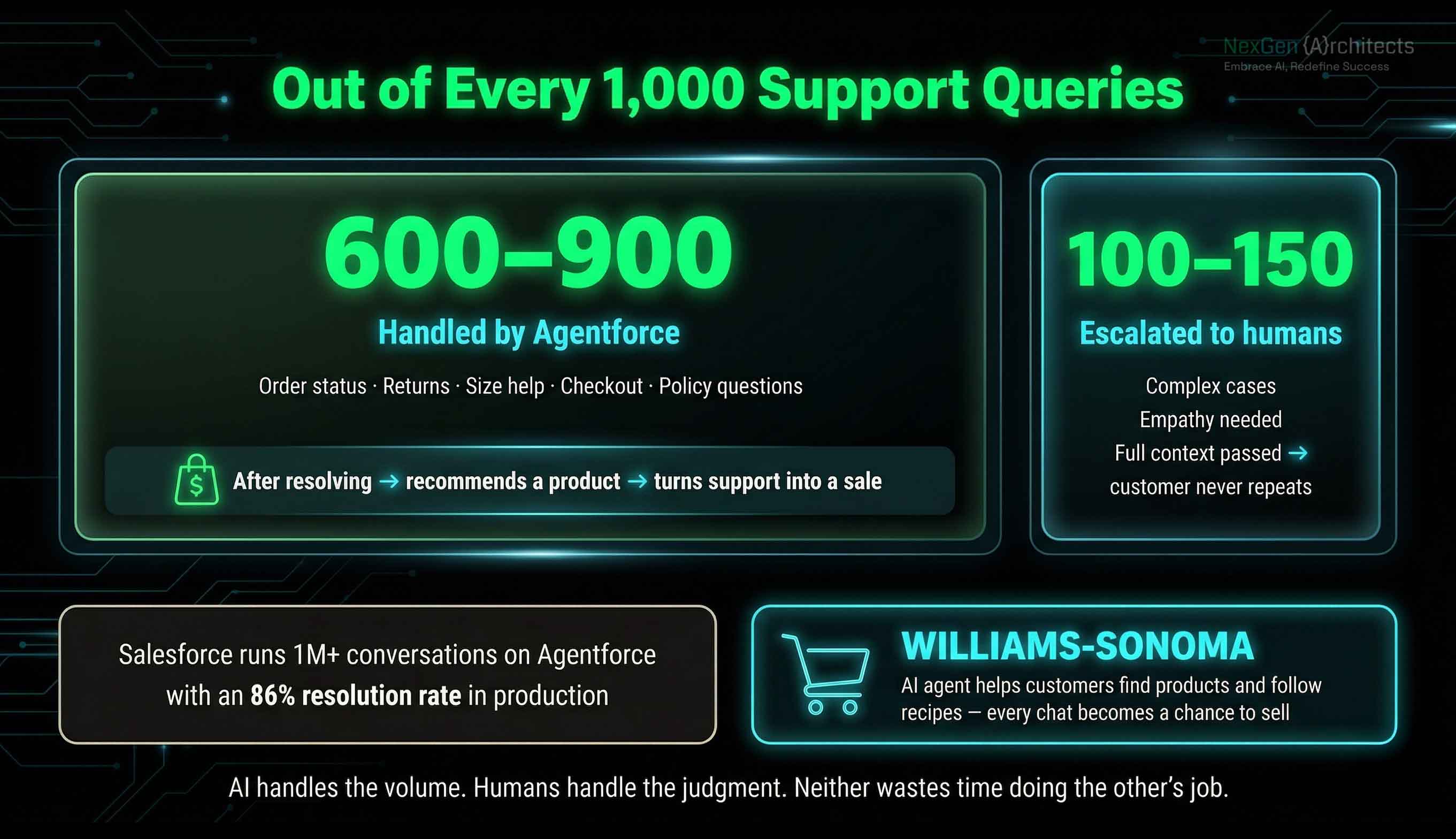
Most retail support interactions end the moment the question is answered. The customer asks about their order status, gets a tracking link, and leaves. That's a missed opportunity.
Agentforce resolves the original query and then stays in the conversation. After confirming a delivery timeline, it can surface a complementary product based on what the customer already bought. "Your running shoes ship tomorrow. Customers who bought these also picked up moisture-wicking socks. Want me to add a pair?"
This turns a zero-revenue support interaction into a sales moment. The recommendation isn't random. It's based on the customer's actual purchase history and real-time inventory. The suggestion feels helpful rather than pushy because it arrives in context, not as a cold marketing email three days later.
Williams-Sonoma already does this in production. They deployed an AI agent on their website that helps customers plan menus, find matching products, and follow recipes step by step. Every support conversation becomes a chance to increase basket size.
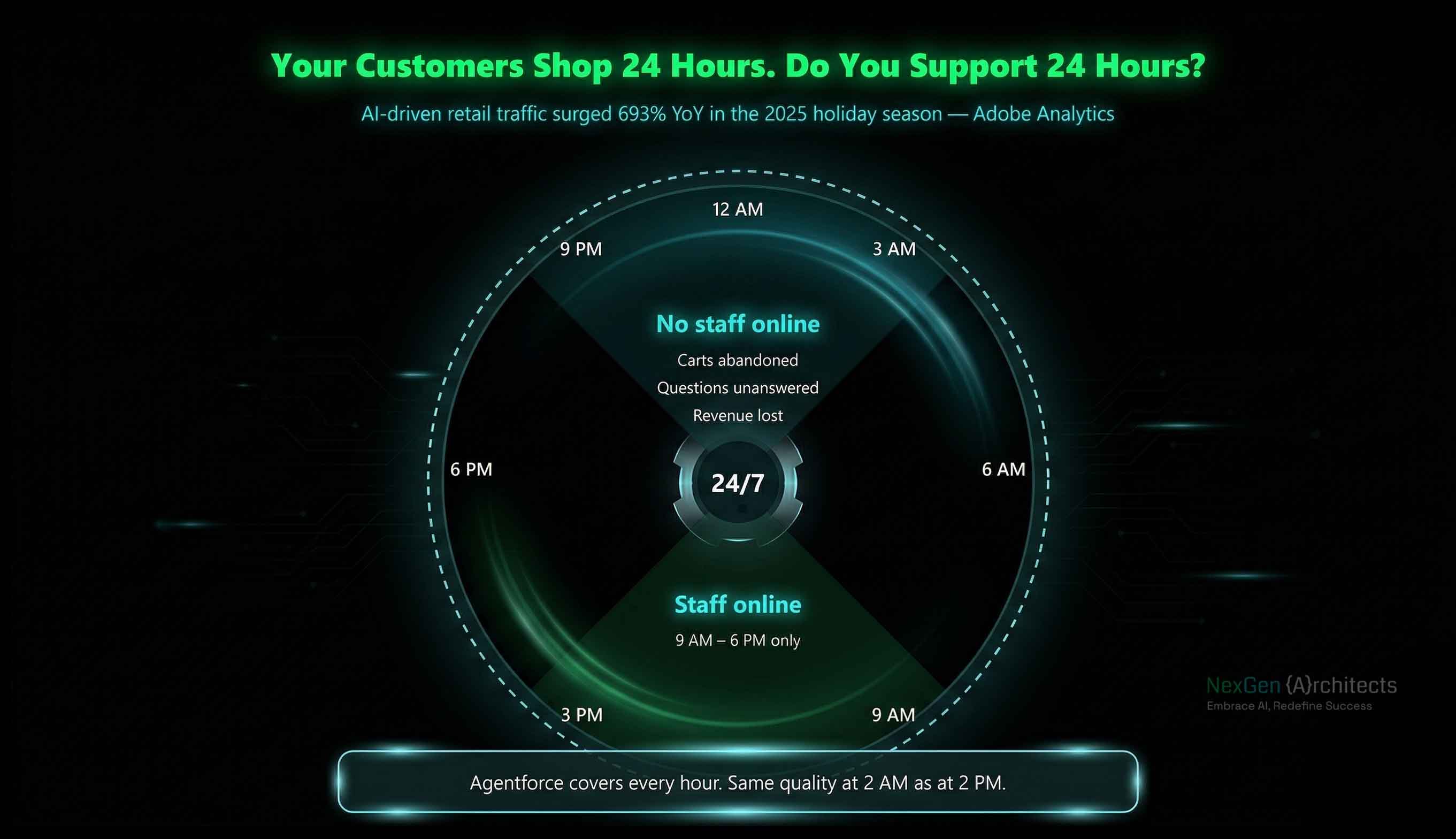
Most retail brands staff support during business hours and maybe extend coverage during peak season. But shopping doesn't stop at 6 PM. A customer browsing at 11 PM who can't find the right size, doesn't understand the return policy, or needs help completing checkout will abandon the cart and may never come back.
Agentforce runs around the clock without shift schedules, overtime, or burnout. During the 2025 holiday season, AI-driven traffic to retail sites surged 693 percent year over year according to Adobe Analytics data covering over one trillion visits. That traffic doesn't arrive between 9 and 5. It arrives at all hours, from all time zones.
The retailers capturing that revenue have always-on AI agents handling product questions, stock checks, and checkout assistance at 2 AM the same way they handle it at 2 PM. The cost per interaction stays flat regardless of volume or time of day. A customer who gets immediate help at midnight is more likely to complete the purchase and more likely to come back.
Returns are unavoidable in retail. The question is whether the experience drives the customer away or brings them back. Most return processes involve waiting on hold, explaining the situation, waiting for approval, receiving a label, shipping the item, and waiting again for the refund. Every step is friction. Every delay erodes trust.
Agentforce compresses the entire process into one conversation. The customer says they want to return an item. The agent checks the purchase date against the return window, verifies the order, generates the shipping label, initiates the refund, and confirms the timeline. If the customer wants an exchange instead, the agent checks inventory for the replacement, confirms availability in the right variant, and processes the swap.
The full interaction takes minutes. No hold time. No transfers. No "let me check with my supervisor." The customer walks away thinking that was the easiest return they've ever done. That feeling is worth more than any loyalty points program because it translates directly into repeat purchases.
Retailers using Agentforce for returns report that customers who have a positive return experience are significantly more likely to buy again within 30 days than customers who had a frustrating one. The return itself loses money. The retention it creates earns it back several times over.
Most ecommerce search is broken. A customer types "blue dress" and gets 4,000 results sorted by some algorithm that doesn't know anything about them. They scroll, get overwhelmed, and either settle for something or leave. Filters help but they're clunky and most shoppers don't use them effectively.
Agentforce changes this by turning search into a conversation. A customer says "I need something for a summer wedding, outdoor, under 200 dollars, and I usually wear a size 8." The agent filters the entire catalog by occasion, price, size, and current stock. It presents a curated shortlist with images and pricing. If the customer says "something more formal," the agent adjusts in real time.
This is how personal shopping works at high-end stores, except it's available to every customer on every channel at any hour. The result is higher conversion because the customer finds what they actually want faster. Cart values increase because the agent suggests matching accessories, shoes, or complementary items that a search bar never would.
The difference between browsing and being guided is the difference between a customer who leaves empty-handed and one who buys three items they didn't know they wanted.
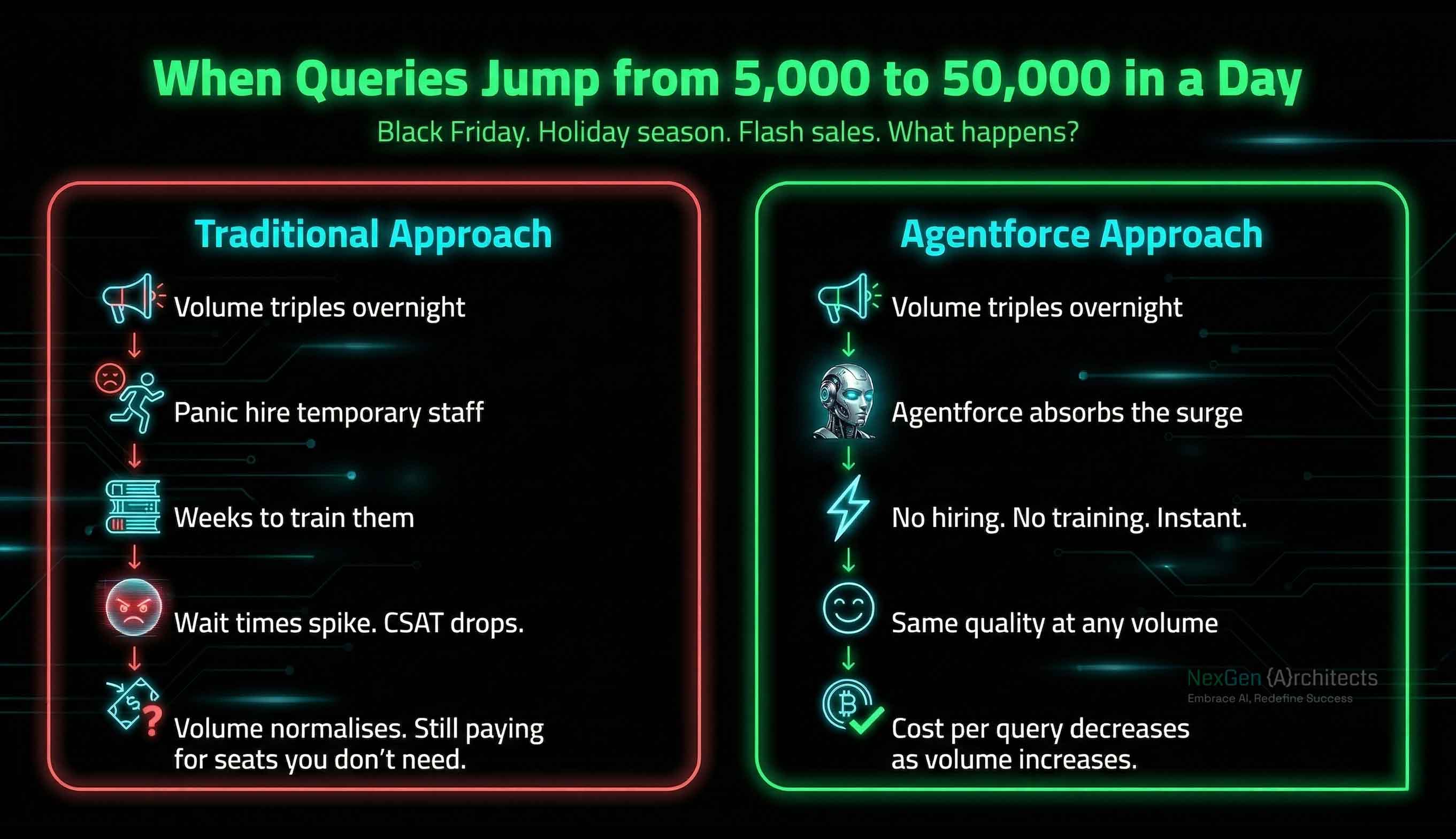
Every retail brand knows the peak season cycle. Volume triples. You hire temporary staff. They take weeks to train. Half of them can't handle edge cases. Customer satisfaction drops because wait times spike. Then volume normalizes and you're paying for seats you don't need.
Agentforce absorbs volume spikes the way cloud servers absorb traffic spikes. When Black Friday hits and query volume jumps from 5,000 to 50,000 in a day, the AI handles the surge without hiring a single person. The cost per interaction actually decreases as volume increases because the marginal cost of each additional AI-handled query is near zero.
Salesforce's own support site handles over one million conversations on Agentforce with an 86 percent resolution rate. That's not a demo. That's production at peak volume.
The humans on your team handle the 10 to 15 percent of cases that genuinely need empathy, judgment, or authority to resolve. Escalated cases arrive with full conversation history so the agent doesn't ask the customer to start over. Your best people focus on your hardest problems instead of reading tracking numbers all day.
The retailers that figure this out stop dreading peak season. Instead of a staffing crisis, it becomes a revenue opportunity because the infrastructure scales with demand instead of breaking under it.
Retail brands that treat support as a cost to minimize will keep hiring, training, and churning staff to answer the same questions every day. The margins will keep shrinking. The customer experience will stay mediocre during the moments that matter most.
The brands using Agentforce for retail are playing a different game. Support interactions generate revenue through contextual recommendations. Returns build loyalty instead of destroying it. Product discovery feels personal at scale. And peak season stops being a staffing emergency.
Every one of these five outcomes depends on one thing: connected data. Agentforce can only resolve queries, recommend products, and process returns if it can access real-time order data, inventory levels, customer profiles, and loyalty records from a single integrated layer. Without that foundation, even the best AI agent becomes another chatbot that says, "let me transfer you.”
If you're evaluating Agentforce for retail, start by assessing whether your data foundation is ready to support it.
Sources:
.svg)

