No items found.
AI
Jan 30, 2024

Learn the 5 critical testing steps enterprises use to prevent AI agent failures, reduce risk, and ensure safe, reliable agent behavior in production systems.
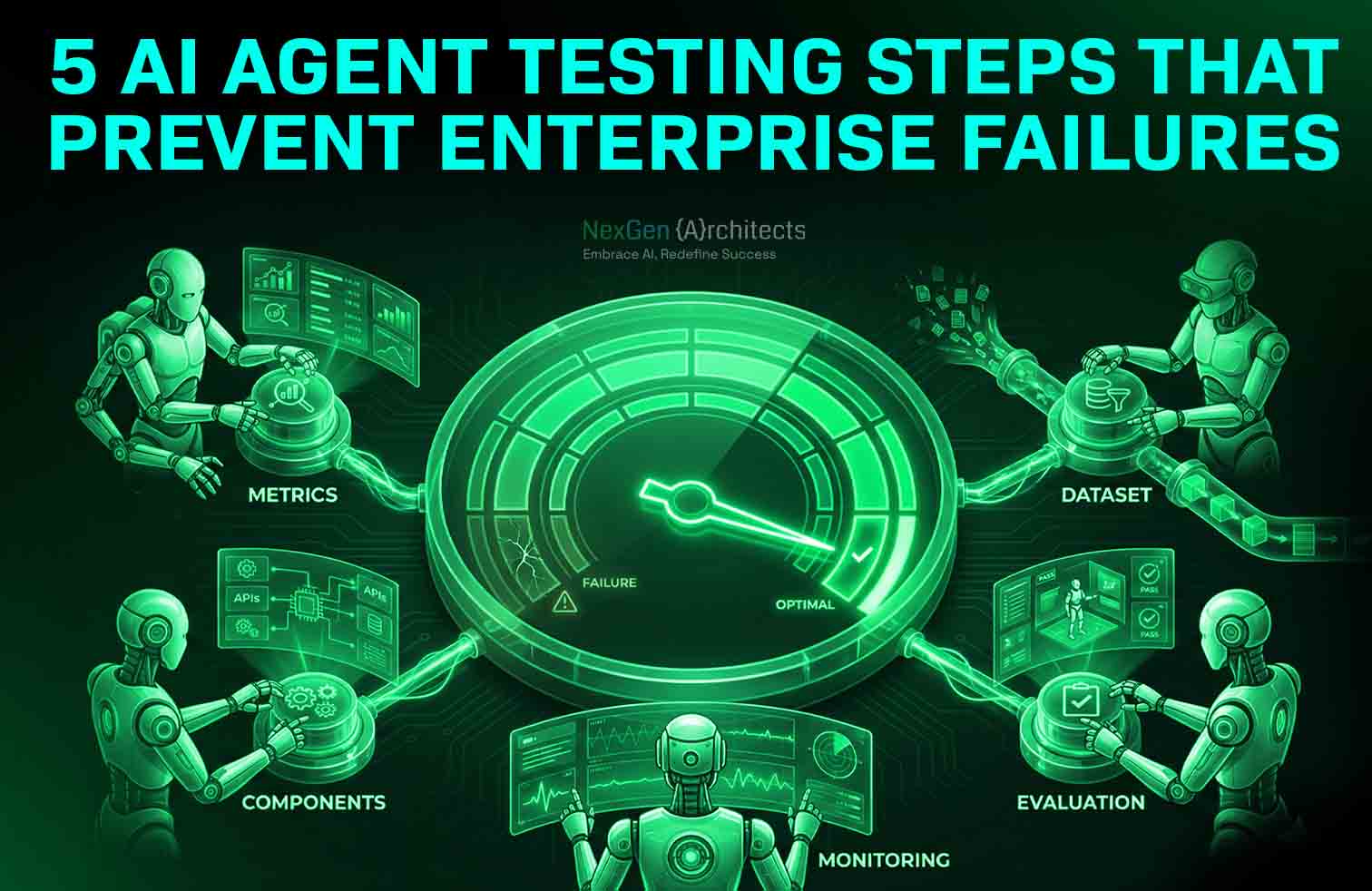
Enterprise AI agents are no longer experimental. They read context, reason over intent, call APIs, mutate data, and trigger downstream systems. That capability fundamentally changes what “testing” means. Traditional QA assumes determinism: given the same input, the system produces the same output. AI agents violate that assumption by design.
In production environments especially those built on platforms like Salesforce, MuleSoft, and API-led ecosystems, the cost of getting this wrong is not a cosmetic bug. It is data leakage, policy violation, financial loss, or silent corruption of business workflows.
This article outlines five testing steps that consistently separate AI agents that survive real enterprise usage from those that collapse after the first unexpected interaction. These are not theoretical best practices. They reflect how large organizations actually test agentic systems operating across CRM, ERP, data platforms, and integration layers.
AI agent testing is the process of validating whether an autonomous system selects correct tools, respects constraints, reasons within bounds, and fails safely under uncertainty across both expected and adversarial conditions.
The problem testing solves is not accuracy alone. It is behavioral reliability in a non-deterministic system.
Most organizations reuse application testing models:
AI agents break this model because:
Testing must therefore shift from output verification to behavioral evaluation.
AI agents fail in production when “good enough” is never defined. Most teams start testing after prompts are written, which reverses the order of responsibility. Evaluation goals must be defined before the agent ever reasons about a task.
This step forces alignment between agent intent and enterprise risk tolerance. Without that alignment, teams confuse helpful behavior with safe behavior. In enterprise systems, those are not interchangeable. An agent can produce a useful response that violates policy, or comply with instructions while creating downstream operational risk.
Production-grade testing therefore requires multiple classes of evaluation metrics. No single score can capture how an agent behaves under ambiguity, scale, and constraint.
Outcome metrics validate whether the agent can complete the task it was designed for:
Behavioral metrics expose how the agent reasons when certainty breaks down:
Safety and governance metrics protect the enterprise, not the user experience:
Operational metrics determine whether the agent survives at scale:
Mature organizations define these metrics before writing prompts. Agents are given narrow, testable objectives. Each objective maps to explicit failure conditions, and human escalation thresholds are defined deliberately rather than discovered after incidents occur. Testing shifts from “Did it answer correctly?” to “Did it behave acceptably under enterprise constraints?”
Most AI agents pass tests because they are evaluated against sanitized inputs. Production environments do not behave that way, and agents trained on clean data rarely survive first contact with real users.
This step exists to expose failure modes that only appear when instructions are ambiguous, constraints conflict, or context is incomplete. These are not edge cases in enterprise systems, they are normal operating conditions.
Enterprise agents interact with incomplete CRM records, outdated policies, inconsistent APIs, and users who do not phrase requests carefully. Testing only happy paths produces agents that appear stable in staging and collapse when reality intervenes.
A production-grade test dataset must deliberately include disorder.
Normal scenarios establish baseline behavior:
Edge cases reveal brittleness:
Adversarial prompts validate guardrails:
Synthetic variations prevent overfitting:
Advanced teams treat datasets as living artifacts. They blend sanitized production logs with synthetic adversarial cases and simulated tool failures. These datasets are versioned alongside agent logic and prompts, ensuring that testing evolves with the agent rather than freezing it in time.
AI agents are systems, not functions. Treating them as monoliths hides failure sources and makes remediation slow and unreliable.
This step isolates where an agent fails. In practice, breakdowns usually occur in one of four areas: reasoning, tool selection, API execution, or state and memory handling. Without separation, teams see symptoms but cannot diagnose causes.
Component-level testing validates deterministic elements. These tests ensure that tools are callable, schemas are correct, permissions are enforced, and routing logic behaves predictably.
Component tests answer one narrow question:
End-to-end testing answers a different and more important question. It evaluates whether the agent can complete a multi-step goal while maintaining context, respecting constraints, and recovering safely from errors.
End-to-end evaluation focuses on:
A common failure pattern illustrates why both layers matter. An agent may infer intent correctly and select the right API, yet execute with incorrect parameters due to context drift. Component tests pass. End-to-end tests fail. In production, data is mutated incorrectly, often without immediate detection.
Leading enterprises structure testing accordingly:
Agents are promoted only when both layers pass defined thresholds.
Fully automated evaluation creates false confidence. Fully manual evaluation does not scale. This step exists to balance speed with judgment where machines are fundamentally limited.
Automated evaluation excels at breadth. It scales across thousands of cases, detects regressions quickly, and enables systematic comparison across prompts and models.
Automated checks typically include:
However, automation breaks down where enterprise risk begins. Subtle policy violations, contextually inappropriate responses, and ethical edge cases often appear reasonable to automated systems.
Human-in-the-loop review is therefore mandatory for high-risk paths.
Human review is essential when:
Mature operating models automate baseline validation, sample human reviews on high-risk scenarios, and feed human feedback back into evaluation datasets. This creates a closed learning loop without delegating responsibility to automation.
Deployment is not the end of testing. It is the beginning of the most valuable phase.
This step captures failure modes that no pre-production environment can fully simulate. Novel user behavior, model updates, data drift, and cost amplification only emerge under real usage.
AI agents evolve implicitly. Models change, context sources shift, business rules are updated, and user behavior adapts. Static tests become stale quickly.
Production monitoring must therefore focus on behavior, not just uptime.
Behavioral signals reveal drift:
Operational signals expose scale risks:
Outcome signals indicate trust erosion:
Leading organizations treat agents as long-running systems. They implement continuous logging and tracing, replay production failures against regression tests, and maintain versioned rollback for agent logic and prompts. Testing becomes a control loop, not a deployment gate.
AI agents fail in production not because models are weak, but because testing assumes determinism where none exists. The five steps outlined here, clear evaluation goals, chaotic datasets, layered testing, human judgment, and continuous monitoring address the real failure modes of agentic systems.
Testing is not a phase. It is the control system that determines whether AI agents remain assets or become liabilities.
Organizations that understand this treat AI agents not as smart features, but as autonomous systems that must be governed, observed, and continuously validated. That distinction is what ultimately determines success at scale.
.svg)

