No items found.
AI
Jan 30, 2024

Know how Salesforce’s acquisition of Informatica creates a unified architecture for trusted data, integration, and autonomous AI reshaping modern enterprise AI strategy.
Enterprise AI has spent enough time promising transformation, yet most organizations remain stuck in the same fragmented systems, inconsistent data, and AI that performs well in demos but falls apart in real business workflows. The gap between what AI could deliver and what enterprises can operationalize has been widening until now.
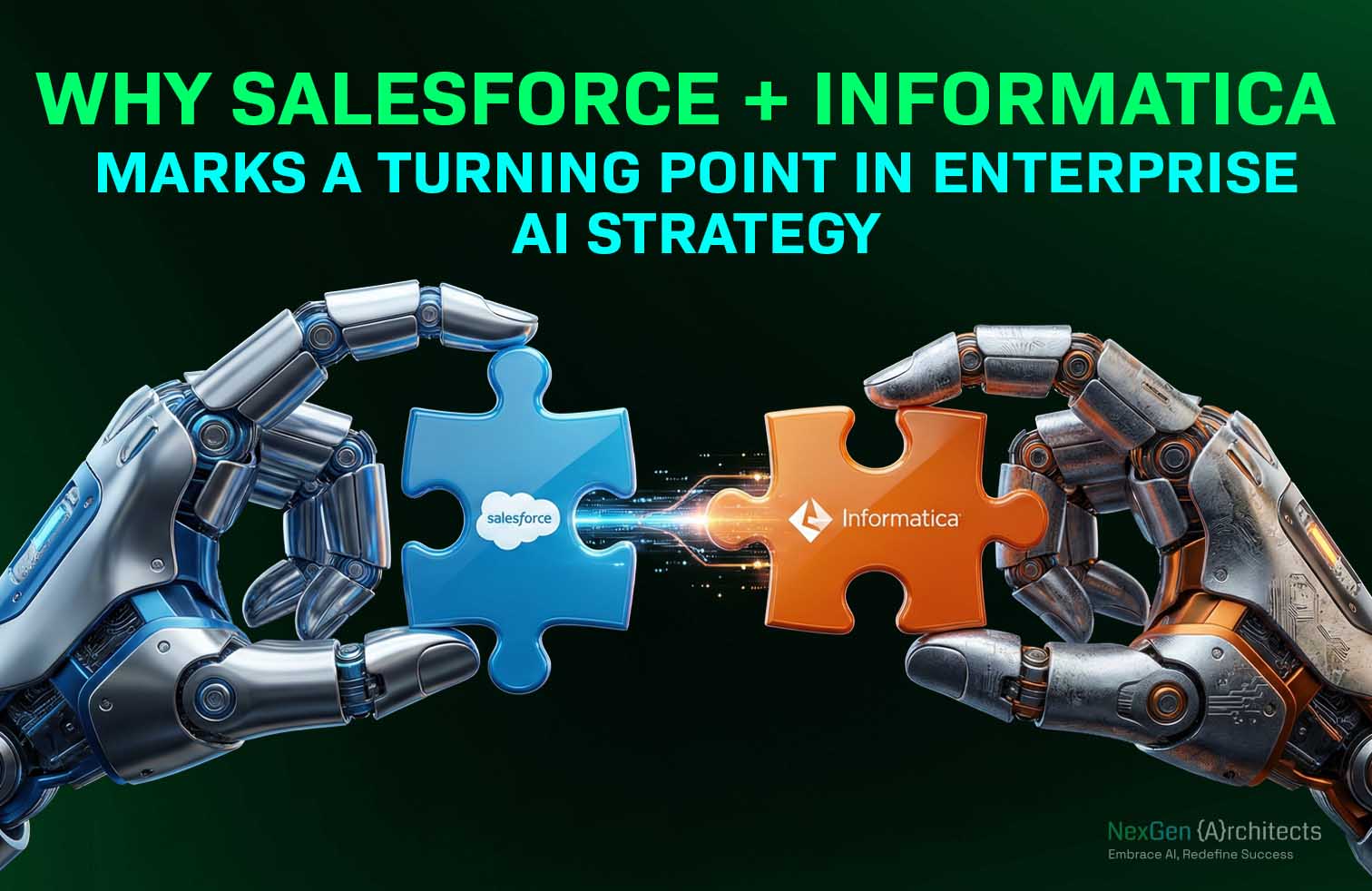
Salesforce’s acquisition of Informatica signals a structural shift in the enterprise technology landscape. Instead of treating integration, data governance, and AI execution as separate layers, Salesforce is bringing them together into a single coherent architecture. MuleSoft, Informatica, and Salesforce Agentforce now operate as one stack creating the most complete pathway yet for AI that acts with context, trust, and accountability.
This is more than a product expansion. It represents a turning point in how enterprises will design their data systems, govern their intelligence, and embed AI into daily operations. The future of enterprise automation is no longer about standalone models or copilots; it’s about AI agents that can reason, take action across systems, and operate safely on governed data. Salesforce is building the platform to make that future practical.
Even with significant investments in digital transformation, most enterprises still operate within highly fragmented landscapes. Systems don’t speak the same language; data flows in ungoverned channels, and critical context is often trapped in isolated applications.
Enterprises continue to face structural issues such as:
These issues explain why AI often works in a pilot but fails in production. Without integrated systems and governed data, intelligence cannot be reliable.
Salesforce and Informatica together address this problem at the platform level.
The most significant outcome from salesforce acquisition of Informatica is the emergence of a genuinely connected platform one where systems, data, and AI can operate seamlessly. This architecture aligns three foundational layers:
MuleSoft integration brings consistent connectivity across applications, API led connectivity, and legacy systems. Instead of relying on brittle point-to-point integrations, enterprises gain a reusable, governed integration foundation.
Informatica delivers enterprise data governance at scale:
This ensures that every AI action is grounded in well-understood, compliant, and high-quality data.
Agentforce sits on top of this foundation and brings the ability for AI to reason, plan, and execute. Agents can initiate workflows, update systems, enforce policy, and coordinate multi-step processes because the layers beneath them are now reliable.
When these components work as one, AI becomes capable of real operational execution, not just advisory support.
One of the most transformative aspects of this integration is the elevation of governance from an optional discipline to a platform-level capability. Informatica’s metadata intelligence and lineage management remove ambiguity from enterprise data, something almost no AI solution can do on its own.
When trusted data is always available:
Clean and governed data is no longer an enabler; it becomes the backbone of AI strategy.
Much of the current enterprise AI landscape focuses on copilots, tools that assist users but do not operate independently. Salesforce is aiming for a more advanced model.
With the combined stack, agents can:
This is possible because the underlying data is trustworthy, and the systems are connected in predictable ways.
It marks the shift from “AI that informs” to “AI that participates in running the business.”
Metadata determines how AI understands and navigates enterprise systems. Salesforce already had a strong metadata backbone within CRM, but Informatica extends this across the entire technology estate ERPs, data lakes, warehouses, and third-party applications.
This unified metadata fabric supports:
AI without metadata guesses. AI with metadata understands. The difference is profound and it’s the foundation of autonomous enterprise operations.
The impact extends across sectors where data fragmentation has historically limited transformation.
Unified data across plant operations, logistics, and dealer systems enables predictive maintenance, accurate planning, and automated supply chain execution.
Governed and lineage-tracked patient data supports compliant AI-driven scheduling, care coordination, and claims automation.
AI can operate within strict regulatory boundaries because every action has traceable lineage and enforced policy.
Real-time decisioning like pricing, inventory routing, and customer engagement becomes possible when loyalty, POS, and supply data converge.
These industries not only get more insights, but they also get more reliable automation.
The Salesforce–Informatica shift forces a rethink of enterprise architecture. Leaders need to reassess:
Organizations that begin this work now will step into the 2026–2028 era with architecture ready for intelligent orchestration.
Salesforce’s acquisition of Informatica marks more than a major industry move. It signals the emergence of a new operating model for the enterprise. By bringing together connectivity, governance, and autonomous AI under a single architecture, Salesforce is creating the first practical pathway to the AI-native enterprise.
This unified stack allows organizations to shift from AI experiments to AI-powered operations. Trusted data becomes the norm, integrations become predictable, and AI agents become responsible actors within the business ecosystem. For enterprises navigating the next decade of digital transformation, this moment represents a clear inflection point.
The future will belong to companies that build on clean data, connected systems, and accountable automation. With MuleSoft, Informatica, and Agentforce now working in concert, Salesforce has laid the foundation for that future—and set a new benchmark for what enterprise AI strategy must look like.
.svg)

