No items found.
Salesforce
Jan 30, 2024

A practitioner-led analysis of how Salesforce Agentforce enables governed, scalable AI agents and prepares enterprises for the emerging agent economy.
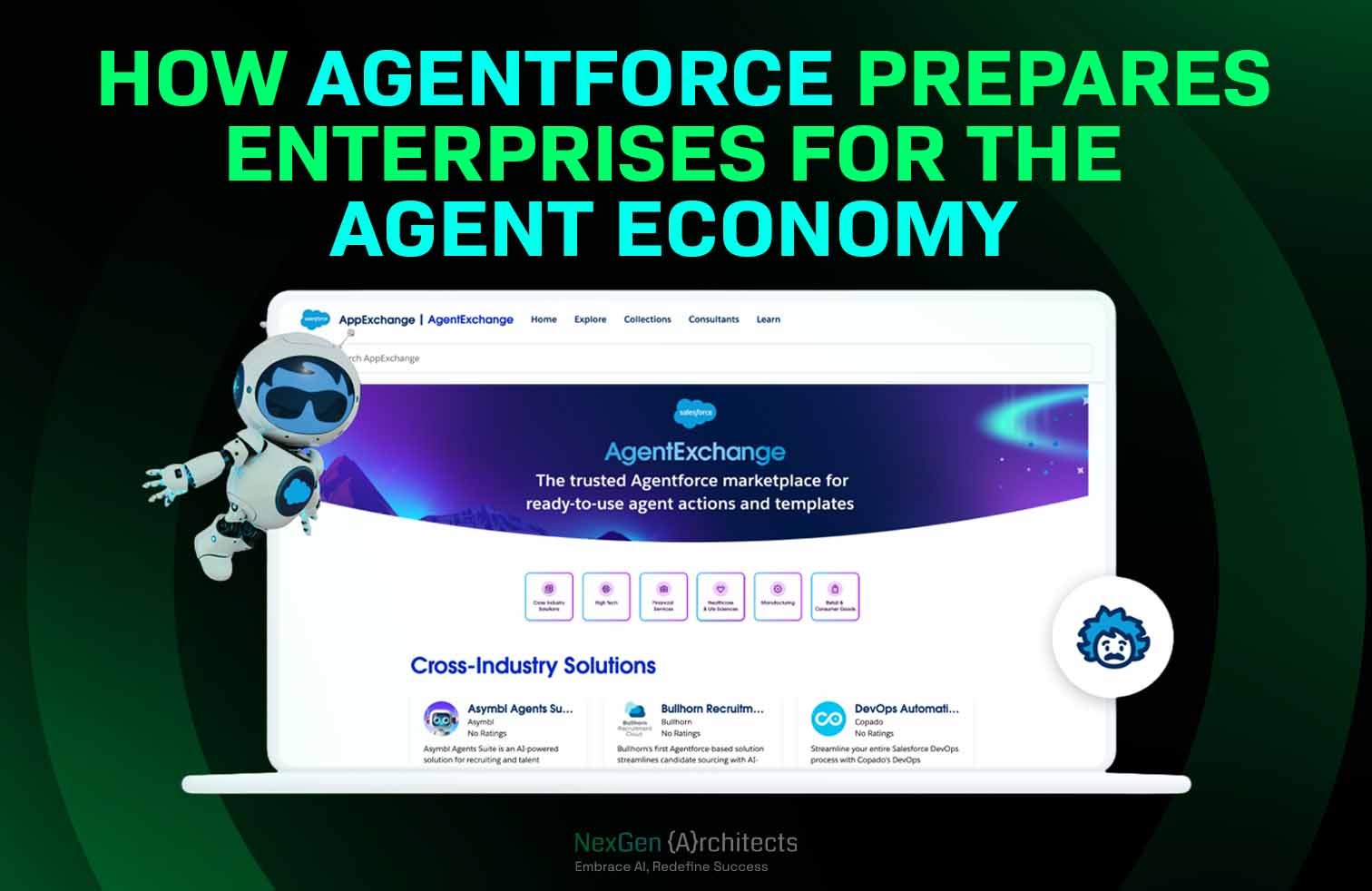
Enterprises are entering a phase where software no longer waits to be instructed. Autonomous agents are beginning to interpret goals, reason over incomplete information, and initiate actions across systems. This shift fundamentally alters how work flows through an organization.
The term agent economy is often used loosely, but in practice it describes something very specific: a business environment where autonomous agents participate directly in value creation. They qualify leads, negotiate timelines, coordinate fulfillment, resolve service issues, and increasingly interact with other agents inside and outside the enterprise.
This transition is not blocked by model capability. Large language models are already sufficient for many forms of reasoning. What blocks adoption is architectural. Most enterprises were not designed to host autonomous actors. They were designed for deterministic systems, human-driven workflows, and tightly scoped automation.
Agentforce matters because it addresses that mismatch at a systems level, not at a feature level.
The core challenge is not intelligence. It is control at scale.Traditional enterprise software assumes that actions are initiated either by humans or by predefined workflows. In both cases, intent is explicit and bounded. Autonomous agents behave differently. They interpret intent, decompose it into steps, and adapt execution based on context. That flexibility is precisely what makes them valuable and dangerous if left unmanaged.
In early pilots, enterprises often experience the same pattern. An agent performs well in isolation, but once connected to real systems it becomes unpredictable. It pulls incomplete data, triggers unintended actions, or produces outcomes that are logically correct but operationally unacceptable.
This happens because agents operate across three dimensions simultaneously:
Without an architectural layer that constrains, observes, and governs this behavior, enterprises lose visibility and trust very quickly.
Most organizations begin their agent journey with prompt-centric designs. A user asks for something, the model responds, and the result is either accepted or discarded. This pattern works well for content generation and analysis, but it collapses when agents are expected to operate.
The reason is simple: prompts have no memory, no accountability, and no native relationship to enterprise state. Once the response is generated, the system has no inherent understanding of what happened, why it happened, or whether it should happen again.
When agents are expected to manage ongoing processes onboarding, renewals, escalations this lack of continuity becomes a liability. Errors cannot be replayed. Decisions cannot be audited. Recovery becomes manual.
Workflow engines and RPA platforms were built to execute instructions, not to interpret goals. They assume the path is known in advance and that exceptions are edge cases. Agents invert that assumption. The path is often unknown, and exceptions are normal.
Enterprises that try to add intelligence to automation usually end up with brittle hybrids. The agent suggests an action, the workflow executes it blindly, and no system understands whether the outcome aligns with business intent. Over time, these systems accumulate hidden risk rather than operational leverage.
Agents do not fail quietly. They fail with confidence. When customer identity, entitlement, and context are fragmented across CRM, billing, service, and marketing systems, agents still reason, but they reason over partial truth. The result is behavior that appears intelligent but contradicts business reality.
This is why agent accuracy cannot be solved purely at the model layer. It must be addressed at the data architecture layer.
Agentforce is Salesforce’s response to these systemic failures. It does not attempt to make agents smarter in isolation. Instead, it embeds agents into the same structural disciplines that made enterprise software reliable in the first place: unified data, governed access, observable execution, and human oversight.
At a high level, Agentforce treats agents as operational actors that must live within enterprise boundaries, not outside them.
Agentforce agents operate natively on top of Salesforce Data Cloud, which resolves identities and unifies customer and operational data across systems. This is not a convenience feature; it is foundational.
Agents that reason over unified data make fewer assumptions. They understand relationships, history, and constraints that would otherwise require human judgment. More importantly, when agents update records, those updates reinforce the same shared truth rather than creating new silos.
This creates a continuous loop where agents read from, reason over, and write back to a consistent enterprise state.
One of the most important design choices in Agentforce is that agents do not interact directly with systems. They act through pre-approved capabilities flows, APIs, skills, and actions that already conform to enterprise governance.
This mirrors how humans operate inside large organizations. Employees do not access databases directly; they operate through systems that encode policy and permission. Agentforce applies the same principle to autonomous agents.
As a result, enterprises can scale agent autonomy without expanding risk proportionally.
Agentforce does not assume that autonomy must be absolute. Instead, it allows organizations to define where agents can act independently and where human review is required.
High-velocity, low-risk decisions can be delegated fully. High-impact or ambiguous decisions can require approval. Crucially, this logic is embedded into execution rather than enforced through after-the-fact review.
This is how enterprises preserve trust while increasing speed.
In a production setting, an Agentforce agent begins with a goal rather than a task. For example, resolving a customer escalation or preparing a high-value account for renewal.
From there, the agent assembles context from CRM data, interaction history, service records, and operational signals. It reasons over that context using Salesforce’s AI layer, decomposes the goal into executable steps, and selects actions that are already sanctioned by the enterprise.
Execution happens incrementally. Each action updates enterprise state, which in turn informs the next decision. Throughout the process, the platform logs inputs, decisions, and outcomes, creating a full operational trail.
This is what differentiates an enterprise agent from a chatbot. The agent is not responding; it is operating.
Organizations that succeed with Agentforce do not start with novelty use cases. They focus on friction points where human coordination breaks down cross-functional handoffs, exception handling, and time-sensitive decisions.
They invest early in integration, ensuring agents can act across systems through well-designed APIs rather than brittle point connections. They define governance boundaries before expanding autonomy, and they monitor agents with the same rigor they apply to production services.
Most importantly, they treat agent behavior as something to be engineered, not hoped for.
A frequent mistake is assuming that agent platforms are simply advanced automation. This leads teams to underestimate the architectural changes required.
Another misconception is that higher model accuracy eliminates governance concerns. In reality, more capable agents amplify both value and risk. Without constraints, intelligence accelerates failure.
Finally, many organizations believe they can add governance later. Experience shows the opposite. Trust, accountability, and coordination must be designed in from the beginning.
Enterprises that are serious about the agent economy recognize that it is not primarily an AI challenge. It is a systems challenge.
They design for agent-to-agent interaction, knowing that future workflows will involve negotiation and coordination between autonomous actors. They harmonize data early, even when it is unglamorous work. They accept slower initial rollout in exchange for long-term stability.
Above all, they recognize that autonomy without architecture is chaos.
The agent economy will not reward the fastest adopters. It will reward the most deliberate ones.
Agentforce prepares enterprises by embedding agents into the structural foundations of enterprise computing: trusted data, governed execution, integration-first design, and observable behavior. It does not remove humans from the system; it elevates them from operators to supervisors of autonomous work.
The question for enterprise leaders is no longer whether agents will participate in their operating model. That is already happening. The real question is whether those agents will operate inside a system designed for trust or force the organization to react after trust is lost.
.svg)

