No items found.
AI
Jan 30, 2024

Most agentic AI fails after demos due to weak system design, missing guardrails, and poor data grounding. Learn how Agentforce fixes production failures.
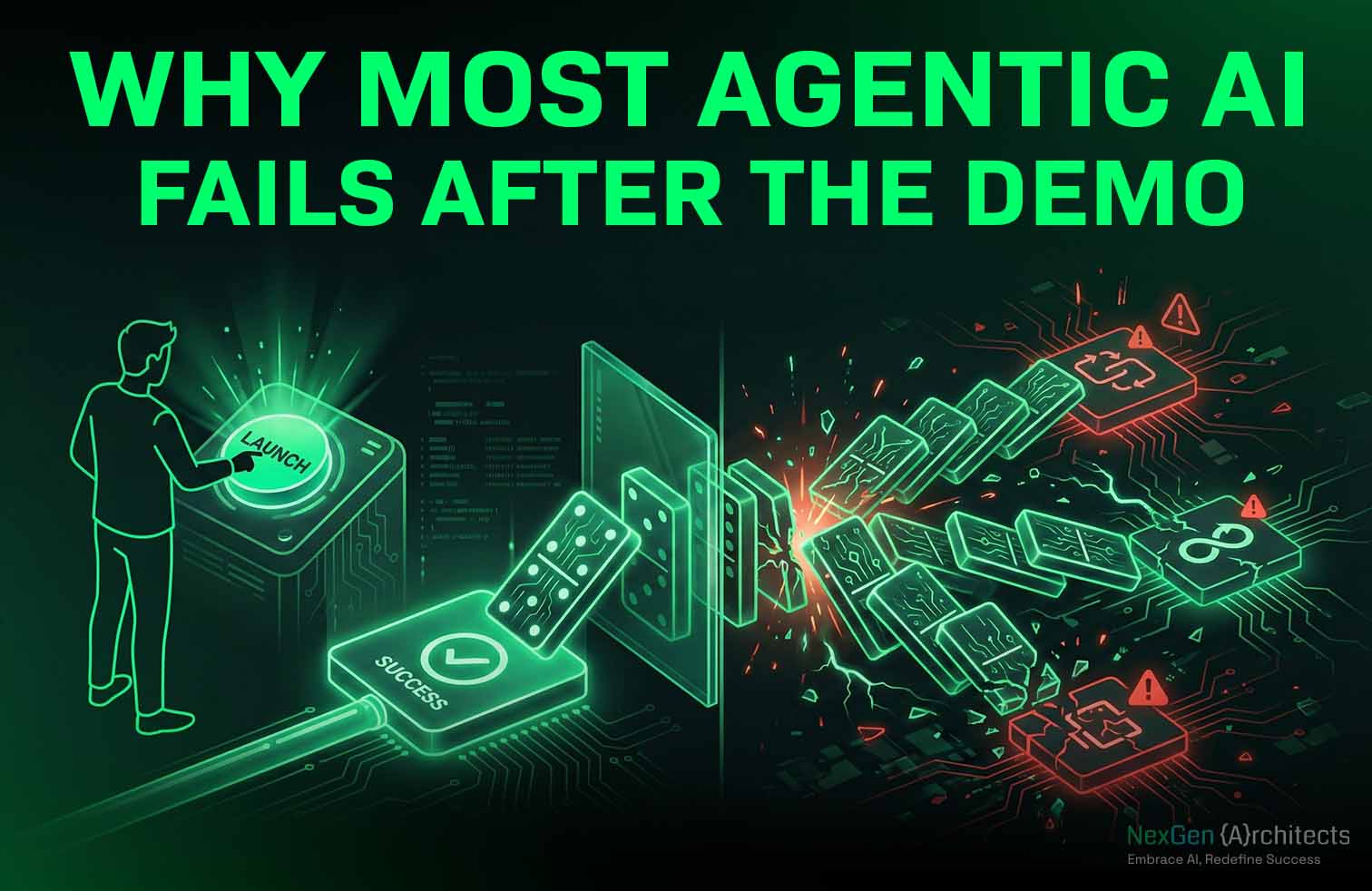
Agentic AI demos usually succeed for a simple reason: demos are staged to remove the very conditions that break agents in production. Inputs are clean, workflows are linear, dependencies respond, and edge cases are conveniently absent. Under those constraints, even a lightly engineered agent, an LLM with tool calls and a thin memory wrapper can look like a step change.
Production introduces a different truth. Enterprise systems are not single applications; they are living networks of policies, identities, integrations, and exception handling. Data is incomplete or delayed. APIs degrade or change. Humans intervene in mid-processes. The agent’s job is no longer answering or calling a tool. It is to operate safely and consistently inside a system that was not designed for probabilistic actors.
That gap between a staged environment and an operational environment is where most agentic AI projects stall. It’s not primarily a model problem. It’s a systems engineering problem.
A useful way to say it in executive language is this: demos prove capability; production demands reliability. If your architecture doesn’t explicitly engineer reliability, the first real workload will expose it.
Agentic AI, done properly, solves a specific enterprise problem: work that requires multi-step coordination across systems and teams, where the next step cannot be fully pre-modeled. That includes situations like escalation handling, renewal risk management, onboarding, entitlement checks, exception routing, and cross-functional coordination where humans are acting as routers and translators.
Traditional automation handles repeatability. Agentic systems aim at adaptive execution where the agent can navigate ambiguity while staying within policy boundaries. When it works, the impact is less about fewer clicks and more about shifting the operating model:
But to get those outcomes, you need something most demo agents do not have: an execution environment that makes autonomy safe.
A demo agent is often assembled as: LLM + tools + a prompt + a memory buffer. That’s enough to show intent decomposition and tool use. It’s not enough to survive enterprise reality because production systems require the same disciplines we expect from any critical service: state management, idempotency, retries, access control, auditability, and observability.
When an agent triggers a refund twice because of a transient failure, that’s not AI being weird. That’s missing idempotency and missing state. When an agent loops on a tool call, that’s not hallucination. That’s missing guardrail logic and missing circuit breakers.
In other words, a large portion of agent failure is normal distributed systems failure just surfaced through an LLM interface.
A lot of teams assume memory means keeping chat history. That works until the interaction spans multiple systems and time windows. Real enterprise work is not a single conversation. It is a sequence of decisions and actions tied to records, identities, entitlements, and policies.
When agents lack an explicit state model, you see these symptoms:
The fix is state anchored in the system of record, with retrieval from trusted enterprise data rather than reliance on conversational residue.
Most executives don’t mind probabilistic language generation in marketing copy. They mind it when the output triggers operational side effects.
In production, inconsistency manifests as:
A demo hides this by being short and controlled. Production exposes it because it is long-running, concurrent, and high-stakes.
The architectural requirement is straightforward: autonomy must be bounded by deterministic controls. You don’t eliminate probabilistic reasoning; you constrain where it can apply and force determinism at the action boundary.
Many teams start by letting agents act, then add human review after something goes wrong. That’s backwards. In enterprise systems, you don’t add approvals later. You design authority upfront who can do what, under which conditions, and how exceptions are handled.
In agentic AI, that authority model must include:
Without this, you don’t have an agent system; you have an unpredictable actor attached to production tools.
Demos rarely face concurrency, p95/p99 latency requirements, cost caps, or rate limits. Production does. When agents are deployed broadly, inefficiencies become budget issues quickly: too many tool calls, too much reasoning, poor caching, repeated retrieval, verbose prompts, and no routing strategy.
What looked like intelligence in a demo becomes trajectory waste in production extra steps that cost time and money without improving outcomes.
The practical failure modes that show up after the demo
In real enterprise rollouts, agentic AI typically fails in a handful of repeatable ways. These are not theoretical they are what operations teams see:
If you’re reading this and thinking, that’s just bad engineering, you’re right. The uncomfortable truth is that many agent initiatives begin before organizations have decided to treat agents as production-grade systems.
Agentforce’s contribution isn’t that it makes agents smart. It makes them operationally viable inside an enterprise platform that already has identity, security, workflow, and data governance. That matters because the failure modes above are not solved by better prompting; they’re solved by tighter coupling to enterprise controls.
Agentforce is designed to operate with Salesforce Data Cloud as the grounding layer. The architectural point here is simple: agents need consistent, unified identity and record context or they will reason over partial truth.
In production, Data Cloud’s value is not just aggregation; it’s harmonization: aligning identities and attributes across CRM, service, marketing signals, and external systems, so the agent’s world model is less fragmented.
This reduces a class of failures that prompt engineering can never fix: actions taken on stale, mismatched, or incomplete customer context.
Where bullets help: the quality improvements show up as:
Enterprise AI breaks reputations through one kind of incident: unauthorized data exposure or unauthorized action. Many agents leak because access control is not enforced at the point of retrieval and action.
Agentforce inherits Salesforce’s permission and security model and applies it at runtime—meaning the agent’s access aligns with the user’s access and the organization’s governance posture.
That’s a critical difference from standalone agent architectures where the agent runs with a service credential and then tries to behave ethically via prompts. Prompts do not enforce access. Platforms do.
Agentforce’s production strength is that you can constrain behavior using deterministic policies: when to ask for approval, which actions require review, what boundaries exist for sensitive operations, and how to handle exceptions.
The key shift is that the action boundary becomes deterministic even if the reasoning path remains probabilistic. That’s how you keep autonomy without accepting chaos.
Examples of guardrails mature teams encode early:
This is the steering wheel most demo agents don’t have.
A common post-demo issue is agent wandering too many steps, unnecessary tool calls, or getting stuck in cycles when a tool fails. Agentforce addresses this with a more structured approach to planning and action execution (often described via Atlas Reasoning capabilities), where goal decomposition and orchestration are treated as first-class concerns.
What matters for production is the practical outcome:
Even if you don’t care how the planner is implemented, you care about one effect: repeatable execution paths.
Agentforce is designed around collaboration: agents handle high-velocity execution; humans intervene on exceptions, risk, and ambiguity. In successful deployments, humans are not asked to review everything. They review the right things, at the right time, based on policy and confidence.
That keeps throughput high while maintaining trust. It also creates a learning loop: overrides and exceptions become signals for improving guardrails and workflows.
The organizations that avoid post-demo collapse implement agentic AI like they implement any enterprise capability: narrow scope, clear authority, instrumentation-first, then scale.
They choose workflows where human time is wasted on routing and stitching across systems typically service escalations, onboarding exceptions, renewal risk, and internal request triage because that’s where agents can produce measurable operational improvement.
Agents are only useful if they can act across systems safely. That means the integration layer must be intentional: versioned APIs, consistent schemas, throttling, and observable calls. Many teams use MuleSoft patterns here because it enforces contract and governance across downstream systems.
They define action classes:
This classification is the difference between controlled scale and reputational risk.
They track operational metrics, not vanity metrics. Practical ones include:
If you don’t measure these, you won’t know whether you’re scaling capability or scaling risk.
Many teams believe the fix is better prompts or a better model. Those help at the margins. They don’t change the core truth: agentic systems are distributed systems with non-deterministic components.
If you treat agents like bots, you get bot outcomes: fragile, opaque, and hard to govern.
If you treat agents like systems, you can engineer for reliability, auditability, and scale.
Agentforce is credible because it’s closer to the second posture than most DIY stacks. It assumes from day one that agents must operate under enterprise constraints.
The post-demo failure of agentic AI is not a mystery. It’s the predictable result of deploying probabilistic actors into deterministic enterprises without the controls those enterprises require.
Agentforce improves the odds because it doesn’t treat agentic AI as an LLM feature. It treats it as an operating model grounded in unified data, constrained by enforceable governance, and designed for human oversight where it matters.
In the agent economy, the winners won’t be the companies with the most impressive demos. They’ll be the companies whose agents can operate safely when data is messy, workflows are fragmented, APIs fail, and outcomes carry real consequences because that is what production always looks like.
For enterprises assessing how to operationalize agentic AI beyond pilots, we provide architecture and managed services aligned with Agentforce, data governance, and enterprise controls. Reach out to explore what a production-grade agent strategy could look like for you.
.svg)

