No items found.
AI
Jan 30, 2024

Explore why MuleSoft is critical to scaling Salesforce Agentforce, enabling trusted AI adoption through integration, governance, and enterprise automation.
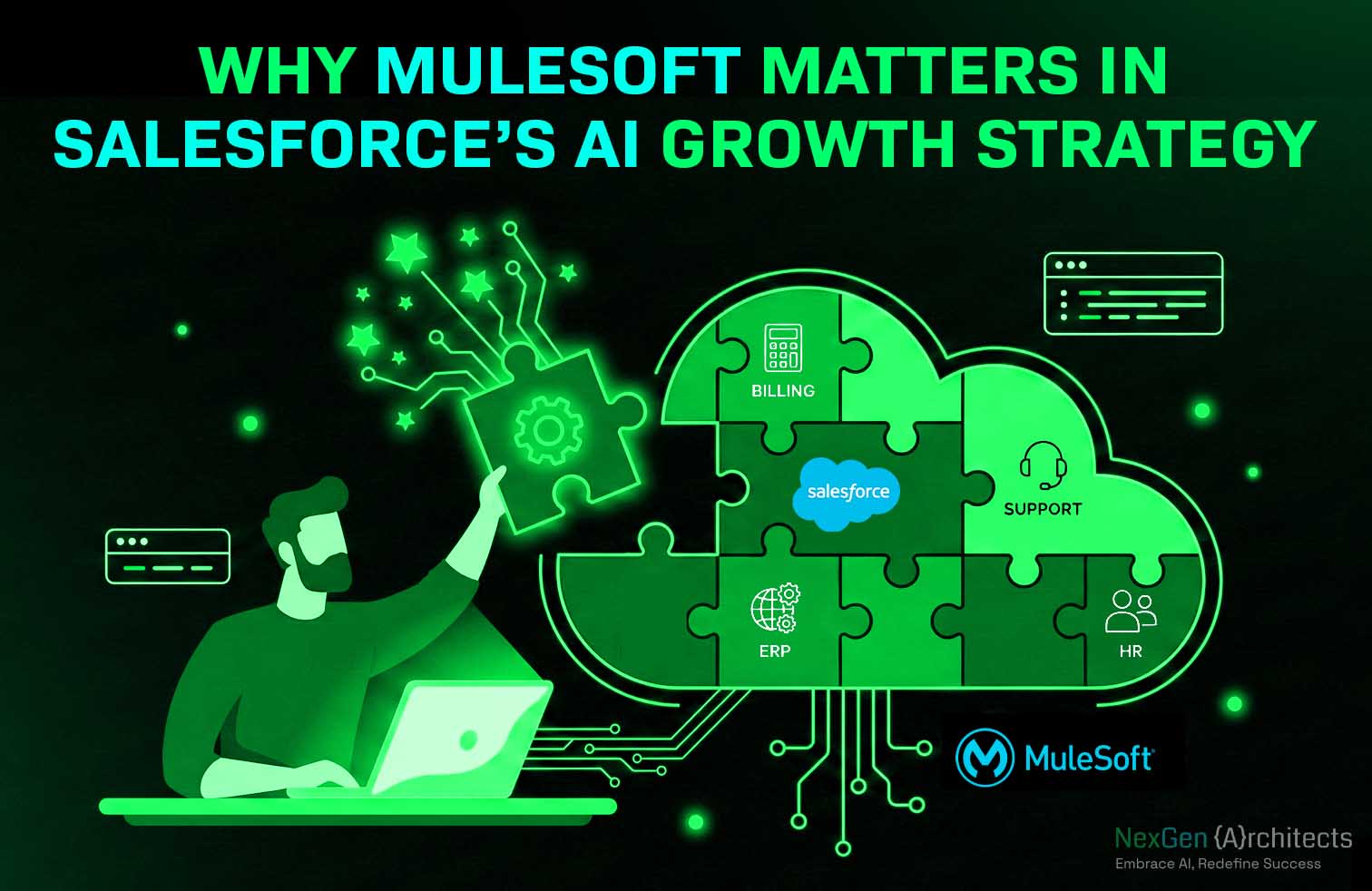
Over the last year, Salesforce has been increasingly open about where it wants to go next. AI is no longer positioned as an add-on or an innovation layer. It’s becoming central to how the platform evolves. Salesforce Agentforce sits right at the center of that change.
Alongside this, Salesforce has shared an ambitious financial target: reaching $60 billion in annual revenue by FY2030. It’s a strong statement of confidence. But behind that number sits a more practical question that many customers and partners are already thinking about: How does AI adoption actually scale across real enterprise environments?
Because today, despite all the momentum around AI, adoption tells a more cautious story.
Only a small percentage of Salesforce customers, roughly 8%, are actively using Agentforce today. That figure is often interpreted as slow adoption, but that’s not quite accurate.
Actually, the interest in AI is high. Most enterprises are actively exploring it. What’s slowing things down isn’t the demand, it’s readiness of it.
AI systems need access to data, context, and workflows to be useful. In many organizations, those elements are still fragmented across applications, legacy platforms, and on-prem systems. Until that foundation is in place, AI remains something teams experiment with rather than rely on.
This is where the conversation stops being about models and starts being about architecture.
Agentforce is designed to reason, act, and automate across business processes. But it can only do that when it’s connected to the systems that actually run those processes.
Customer data might live in Salesforce, but orders, billing, inventory, HR, finance, and support systems often don’t. They live elsewhere, sometimes across multiple clouds, sometimes on-prem, and sometimes in tools that were never designed with AI in mind.
MuleSoft becomes critical at this point. By connecting Salesforce to the broader enterprise landscape, MuleSoft allows Agentforce to operate with real context. AI agents can pull accurate data, trigger actions in downstream systems, and respond based on what’s actually happening in the business, not just what’s visible inside a single platform.
Without this layer, AI remains limited. With it, AI starts to behave like an operational capability rather than a smart assistant.
Another reason for AI adoption stalls is trust. Enterprises need to know how decisions are made, how data is accessed, and how actions are controlled.
MuleSoft has always been strong in this area. Its integration approach doesn’t only move data but also applies policies, enforces security, and provides visibility into how systems interact. That same discipline matters even more when AI is involved.
When Agentforce operates through governed integrations, organizations gain confidence. They can control what data agents access, how actions are executed, and how compliance requirements are met. This isn’t optional for regulated industries or large enterprises, it’s the difference between experimentation and production use.
AI that bypasses governance rarely scales. AI that operates within it usually does.
Most early AI initiatives start small: a support assistant here and a reporting helper there. The real value appears when AI begins to span workflows end to end.
This is where MuleSoft again acts as a multiplier.
When integrations and automation are already in place, Agentforce can move beyond individual tasks. It can orchestrate processes across systems, reduce manual handoffs, and ensure actions are consistent. At that point, AI outcomes can be measured not only in productivity gains, but also in revenue impact, cycle time reduction, and customer experience improvements.
This is the stage where AI stops being a “pilot” and becomes part of day-to-day operations.
Salesforce’s growth target assumes that Agentforce adoption expands far beyond today’s early users. That expansion depends less on AI sophistication and more on enterprise enablement.
MuleSoft addresses the exact constraints that limit scale:
In practical terms, MuleSoft shortens the path from interest to adoption. It helps customers move faster, with less risk, and with clearer outcomes.
Salesforce’s AI strategy is ambitious, but it’s grounded in reality that many enterprises already understand AI does not succeed on its own. It succeeds when it’s supported by strong integration, governance, and automation.
MuleSoft provides that foundation.
For organizations looking to scale AI in a meaningful way and for Salesforce customers who want to move beyond experimentation, the real work starts underneath the AI layer. The systems need to be connected. The rules need to be enforced and the workflows need to be ready.
That’s how AI adoption grows from 8% to something much larger and how Salesforce’s broader growth ambition becomes achievable.
.svg)

