No items found.
AI
Jan 30, 2024

Explore whether Salesforce is rebranding to Agentforce, why Marc Benioff is moving away from “cloud,” and what this shift means for AI agents and enterprise software.
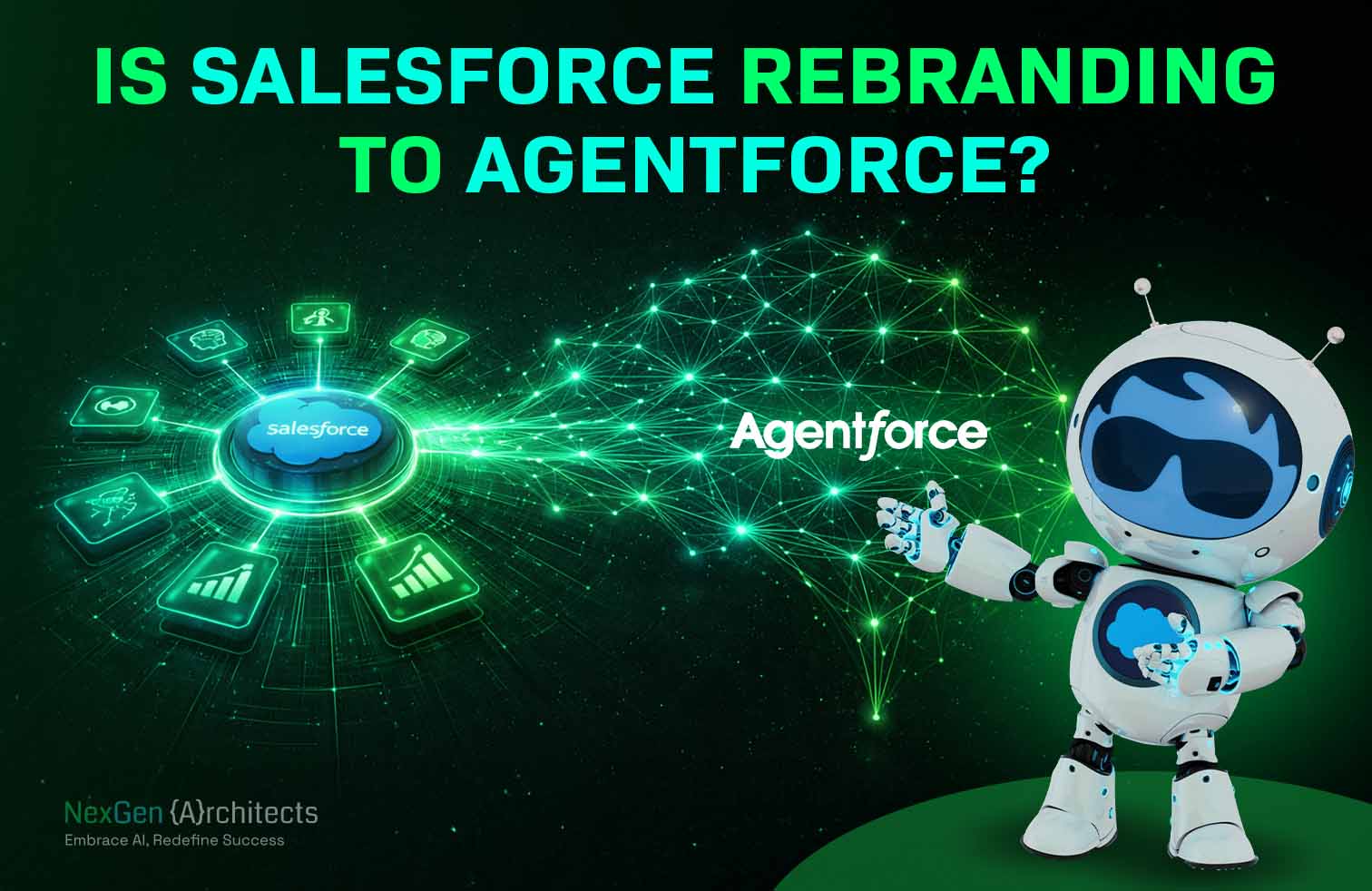
Rumors of Salesforce potentially renaming the company to “Agentforce” have triggered substantial discussion across the ecosystem. While the idea first surfaced casually through employee commentary, Marc Benioff later acknowledged in an interview that such a change “might” happen. The comment, although not a formal announcement, is significant because it reflects how Salesforce is repositioning itself during one of the most consequential technological transitions in enterprise software: the shift from cloud platforms to AI agents.
In this discussion, we examine why the conversation emerged, the strategic motivations behind it, the reactions across the ecosystem, and what the potential rebrand signals about the future of enterprise technology.
For more than two decades, “cloud” has been the foundational concept shaping enterprise IT strategy. Salesforce built its identity around the idea and became one of the world’s most recognizable cloud-native companies. However, recent customer focus groups conducted before Dreamforce revealed a notable change in sentiment. According to Benioff, customers no longer frame their needs around cloud adoption. Instead, they express interest in solutions capable of autonomous execution, intelligent reasoning, and measurable business outcomes delivered through AI agents.
This change in buyer language and expectations explains why Benioff has deliberately removed the term “cloud” from Salesforce’s public messaging. The rebrand of Data Cloud to Data 360 and the renaming of Sales Cloud and Service Cloud under the Agentforce portfolio reflect a broader realignment. Salesforce is positioning itself not as a cloud software provider but as an operating system for agentic work.
The growing emphasis on Agentforce is not merely branding; it reflects the product’s rapid adoption and its alignment with enterprise needs. Agentforce has already surpassed $500 million in ARR and is growing at a rate of more than 300% year-over-year. This momentum signals a structural change in how organizations are approaching productivity, automation, and operational scalability.
Agentforce represents a different category of enterprise capability. Instead of users navigating applications, Agentforce enables businesses to deploy autonomous agents that:
This fundamentally changes the role software plays inside organizations. It is not simply a system of record or a process interface; it becomes an active participant in execution.
For SMB and mid-market companies, the appeal is especially clear. Autonomous agents reduce the need for repetitive work, accelerate customer-facing processes, and prevent manual bottlenecks leading to more predictable operations without increasing headcount.
If Salesforce were to rename itself to Agentforce, the move would fit a broader pattern in the technology industry. Several tech giants have undertaken large-scale rebrands to signal their long-term vision; Google becoming Alphabet and Facebook becoming Meta being two prominent examples.
A corporate transition from Salesforce to Agentforce would communicate several strategic messages:
Such a change would also reframe how customers evaluate ROI. Traditionally, businesses purchased Salesforce to manage processes. Under an Agentforce identity, the focus shifts to measurable task completion, operational acceleration, and resource optimization.
The rumor of a rebrand has drawn varied reactions across the Salesforce community.
Some practitioners and analysts believe a new corporate name would more accurately represent the company’s evolution. They argue that Salesforce has long expanded beyond its sales origins and that aligning the brand with its agentic ambitions would clarify its long-term strategic direction.
Supporters also note that AI is reshaping the software industry, and a clear identity centered around intelligent agents could position Salesforce ahead of market expectations.
Others caution against the risk of customer confusion, especially given Salesforce’s history of frequent product renaming. These critics highlight that Salesforce’s strongest competitive position still lies in Sales Cloud and that distancing the brand from its most recognized capability could dilute its identity.
There is also skepticism regarding timing. While Agentforce has shown early traction, some customers remain uncertain about its real-world performance, pricing structure, and maturity. A corporate rebrand before the ecosystem fully embraces agentic workflows may be premature.
To summarize, opinions diverge not on whether Salesforce is moving toward an agent-first world; that trend is clear, but on whether the company should anchor its entire identity around it today.
Even if Salesforce ultimately decides not to adopt the Agentforce name, the direction is unmistakable. The company is reorienting itself around AI agents as the next generation of enterprise productivity infrastructure. This shift represents a broader industry change: organizations are beginning to view software not as a set of screens but as a system capable of autonomous execution.
In this new environment, leaders will evaluate platforms based on:
This perspective fundamentally changes how companies approach digital transformation.
Whether Salesforce formally adopts the Agentforce name or keeps its established identity, the underlying shift is already underway. The company has repositioned its products, language, and strategy around autonomous agents, and customers are beginning to adopt this new model of work.
The more important question for business leaders is not whether Salesforce will rebrand, but how prepared their organizations are for agent-driven execution. Companies that identify the workflows, decisions, and processes suitable for agentic automation today will be better positioned to operate with speed, resilience, and efficiency as this new era unfolds.
Salesforce may or may not become Agentforce. But the enterprise landscape will unquestionably become more agentic and far sooner than many expect.
.svg)

