

Key Takeaways
- AI-driven shopping traffic to retail sites grew 119% year-over-year during the 2025 holiday season. Customers are already discovering and buying products through AI conversations instead of traditional browsing.
- Agentic commerce turns one-way marketing messages into two-way purchasing conversations across email, SMS, WhatsApp, and AI search platforms like ChatGPT.
- The retailers who benefit most are the ones whose product data, inventory, and customer profiles are already unified. Agentic commerce amplifies clean data and exposes fragmented data.
A customer receives a WhatsApp message about a promotion. Instead of clicking a link, opening a browser, finding the product, and checking out, they reply to the message. An AI agent confirms the product, applies the discount, takes payment, and confirms the order. The customer never leaves the conversation.
This is agentic commerce. It is happening now. And it changes how retail organisations think about merchandising, fulfilment, customer data, and channel strategy.
According to Salesforce, AI-driven traffic to retail sites surged 119% during the 2025 holiday season. Morgan Stanley projects that nearly half of online shoppers will use AI shopping agents by 2030, accounting for approximately 25% of their total spending. The shift from browsing to conversational buying is accelerating faster than most retail operations teams have planned for.
This blog explains what agentic commerce actually means for retail operations, what it requires from your data and systems, and where it creates the most value and the most risk.
What Is Agentic Commerce and Why Should Retail Leaders Care?
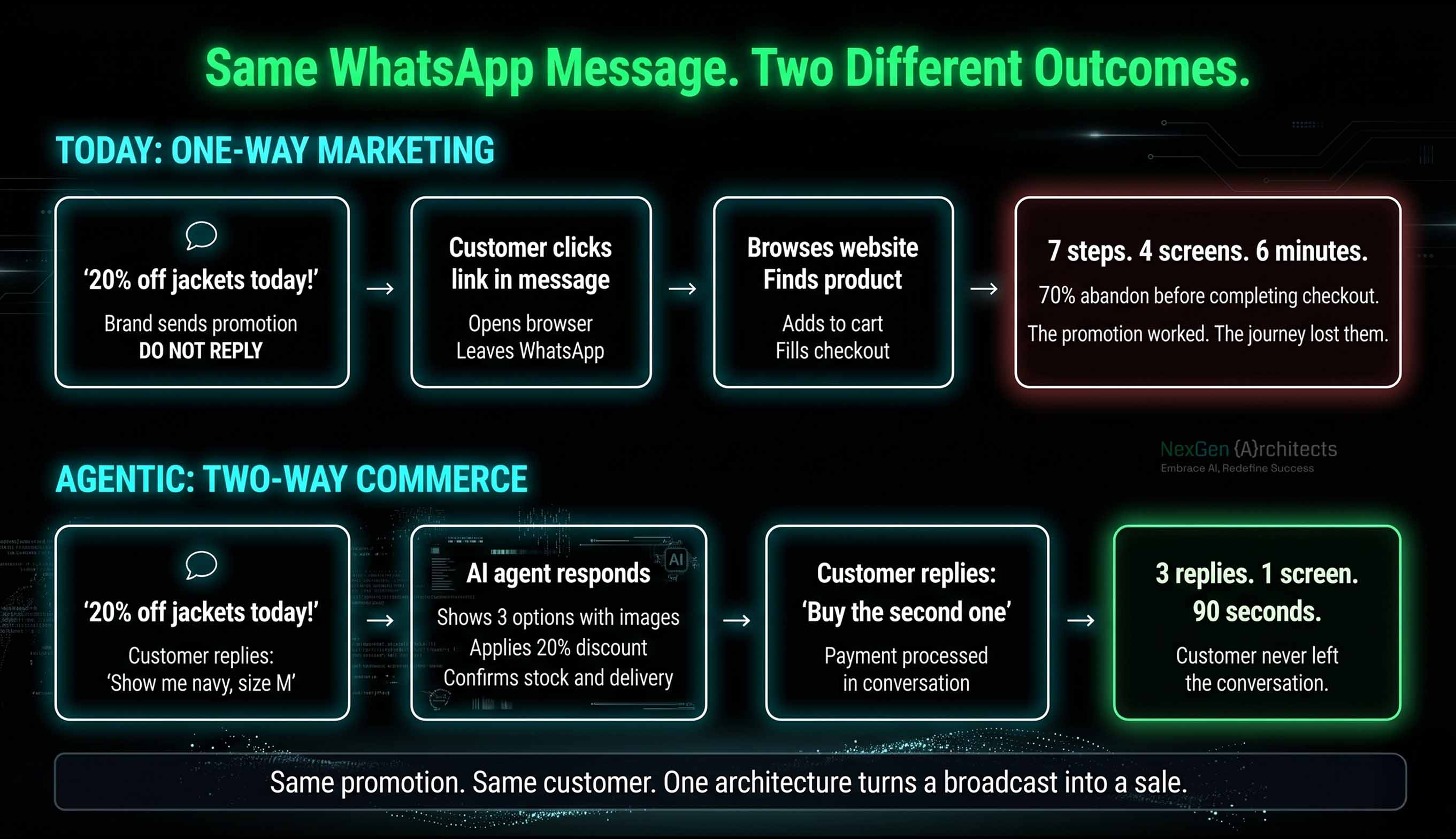
Agentic commerce means AI agents that can discover products, recommend options, answer questions, apply promotions, process payments, and complete orders on behalf of customers, across any channel, without the customer visiting a website.
This is fundamentally different from chatbots. A chatbot answers questions. An agentic shopping assistant completes transactions. It reasons through the customer's intent, accesses live inventory and pricing data, personalises recommendations based on behaviour, and closes the sale inside the conversation.
For retail leaders, this matters because it changes three things simultaneously:
Where customers discover products
Shoppers increasingly find products through ChatGPT, Google AI search, and conversational assistants instead of typing keywords into a search bar. Retailers whose product catalogues are structured for AI discovery will capture this traffic. Those whose catalogues are optimised only for traditional search will become invisible on these new channels.
How customers buy
Marketing messages that were previously one-way (email blasts, SMS promotions, WhatsApp notifications) become two-way purchasing channels. A customer can reply to a promotional text and complete the purchase within that conversation. The boundary between marketing and commerce disappears.
What data powers the experience
Agentic commerce only works when the AI agent has real-time access to accurate inventory, pricing, customer history, and fulfilment capacity. Fragmented data produces wrong recommendations, overselling, and failed orders at a speed and scale that manual processes never could.
How Agentic Commerce Changes Merchandising
Traditional merchandising relies on manual rules: boost this product, bury that one, create sorting logic for each category page, adjust promotions weekly. This process is slow, labour-intensive, and reactive.
Agentic merchandising reverses this. AI agents analyse real-time sales data, inventory levels, margin targets, and customer behaviour to make merchandising decisions autonomously:
- A product trending upward gets boosted automatically across search results and recommendations
- A product running low on stock gets deprioritised before it oversells
- A high-margin item gets surfaced to customers whose purchase history suggests they are likely to buy it
The merchandiser's role shifts from configuring rules manually to setting objectives and guardrails that the AI operates within. The speed advantage is significant. A human merchandiser adjusting rules across thousands of products cannot react to demand changes within hours. An AI agent can react within minutes.
The risk is equally significant. If inventory data feeding the AI is 12 hours stale, the agent promotes products that are already sold out, creating a worse customer experience than the manual process it replaced.
Why Contextual Search Changes How Customers Find Products
Keyword search is how retail websites have worked for two decades. The customer types "lightweight jacket," the search engine matches those exact words against product titles and descriptions and returns results. If the retailer tagged the product as "windbreaker" instead of "lightweight jacket," the customer sees nothing.
Contextual search understands intent instead of matching words. The same "lightweight jacket" query returns windbreakers, travel jackets, and layering pieces because the system understands what the customer actually wants, taking into account their location, the current season, their browsing history, and their past purchases.
For retail operations, this has two implications:
1. Product data quality becomes critical
Contextual search uses product attributes, descriptions, and metadata to understand what a product is and who it is for. Retailers with incomplete or inconsistent product data will deliver poor results even with the best AI, because the system has nothing meaningful to reason about.
2. Search and merchandising converge
When the search engine understands intent, it can personalise results the same way a merchandiser would. The distinction between "search results" and "curated collections" blurs. The AI delivers both simultaneously based on who is searching and what they are likely to buy.
What This Requires from Your Integration Layer
Every capability described above depends on real-time, accurate data flowing between systems. An AI shopping agent that recommends a product needs live inventory data. An agentic merchandiser that boosts trending items needs real-time sales data. A contextual search engine that personalises results needs unified customer profiles.
The retailers most prepared for agentic commerce are the ones who already solved their integration problem:
- Commerce platform, OMS, and ERP share inventory data in real time instead of through overnight batch syncs
- Customer profiles are unified across online, in-store, and marketing channels through a data platform
- Product data is consistent, complete, and structured for AI consumption across every channel
- Payment, fulfilment, and compliance systems are connected through governed APIs instead of custom scripts
The retailers least prepared are the ones running disconnected systems with 12-hour data lags, inconsistent product catalogues, and fragmented customer records. Agentic commerce will amplify those gaps, because AI agents operate at a speed and volume that makes stale data and broken connections visible to customers within minutes instead of days.
Where Agentic Commerce Creates the Most Operational Risk
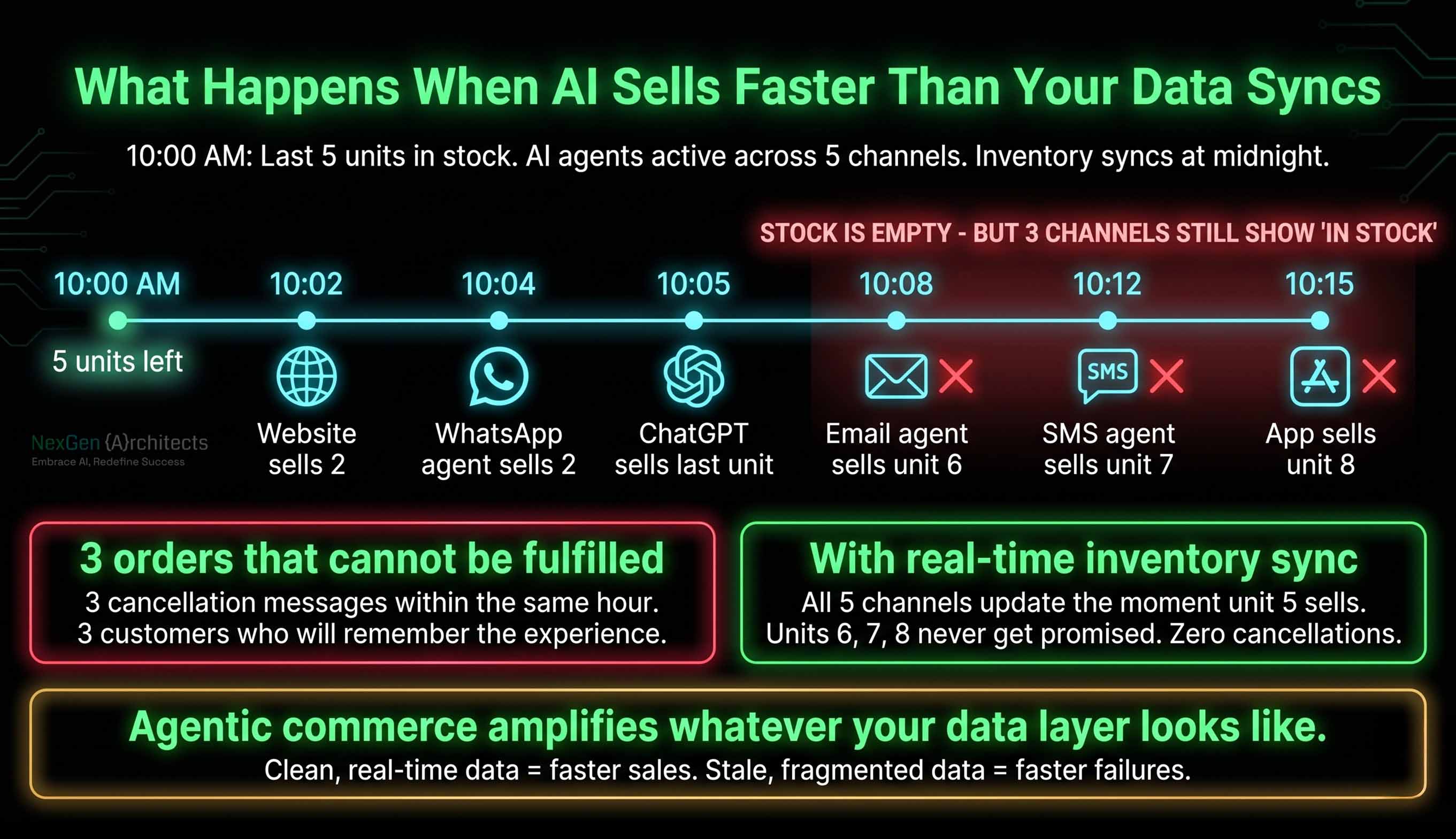
The enthusiasm around agentic commerce is warranted. The risk is underestimated.
Overselling at AI speed
When a traditional website oversells a product, one customer gets a cancellation email. When an AI agent operating across email, SMS, WhatsApp, and ChatGPT simultaneously oversells a product, dozens of customers get cancellation messages within the same hour, because the agent processed orders faster than the inventory sync could keep up.
Brand control across third-party channels
When your product catalogue feeds into ChatGPT or Google AI shopping, you control less of the customer experience. How the AI presents your product, what competitors it surfaces alongside yours, and how it handles pricing and availability are all determined by the AI platform, not your brand.
Compliance across conversational channels
Completing a purchase inside a WhatsApp conversation raises questions about consent tracking, payment security, and data privacy that traditional checkout flows handle through established processes. Conversational commerce requires those same protections in a new format.
How to Prepare Without Overcommitting
The retailers getting value from agentic commerce in 2026 are approaching it the same way: start with what you can control, prove it works, then expand.
1. Fix the data foundation. Unify inventory, customer profiles, and product data across your commerce platform, OMS, and ERP. If these systems still sync overnight, agentic commerce will expose every gap at scale.
2. Deploy conversational capabilities on owned channels first. AI-guided shopping on your own website and app, where you control the experience and the data, before extending to third-party AI platforms where you have less control.
3. Structure your product catalogue for AI discovery. This means complete attributes, consistent descriptions, and structured data that AI agents can reason about, across every channel.
4. Measure what matters. Conversion rate through AI-assisted shopping versus traditional browsing. Cart size difference. Return rate difference. Customer satisfaction difference. The data will tell you where to expand and where to hold.
The retailers who wait for agentic commerce to mature before acting will find that their competitors already captured the customers who shop through conversations instead of catalogues. The ones who move now, with their data unified and their systems connected, will set the pace for everyone else.
Conclusion
Agentic commerce rewards the retailers who prepared their data foundation and punishes those who did not. The technology is ready. The customer behaviour has shifted. The only variable left is whether your systems can keep up with AI agents that sell across five channels simultaneously. The retailers moving first are the ones whose inventory, customer profiles, and product catalogues already speak the same language across every system.
The ones still running overnight batch syncs between their commerce platform, OMS, and ERP are about to discover what happens when AI moves faster than their architecture allows. That gap closes now or it widens permanently. If your retail systems need to be connected before agentic commerce exposes what is broken, that conversation starts with the right integration partner.

.svg)

