No items found.
AI
Jan 30, 2024

Vibe coding is reshaping Salesforce development, shifting from syntax-heavy work to natural language workflows, powered by AI, Apex, flows, and Agentforce.
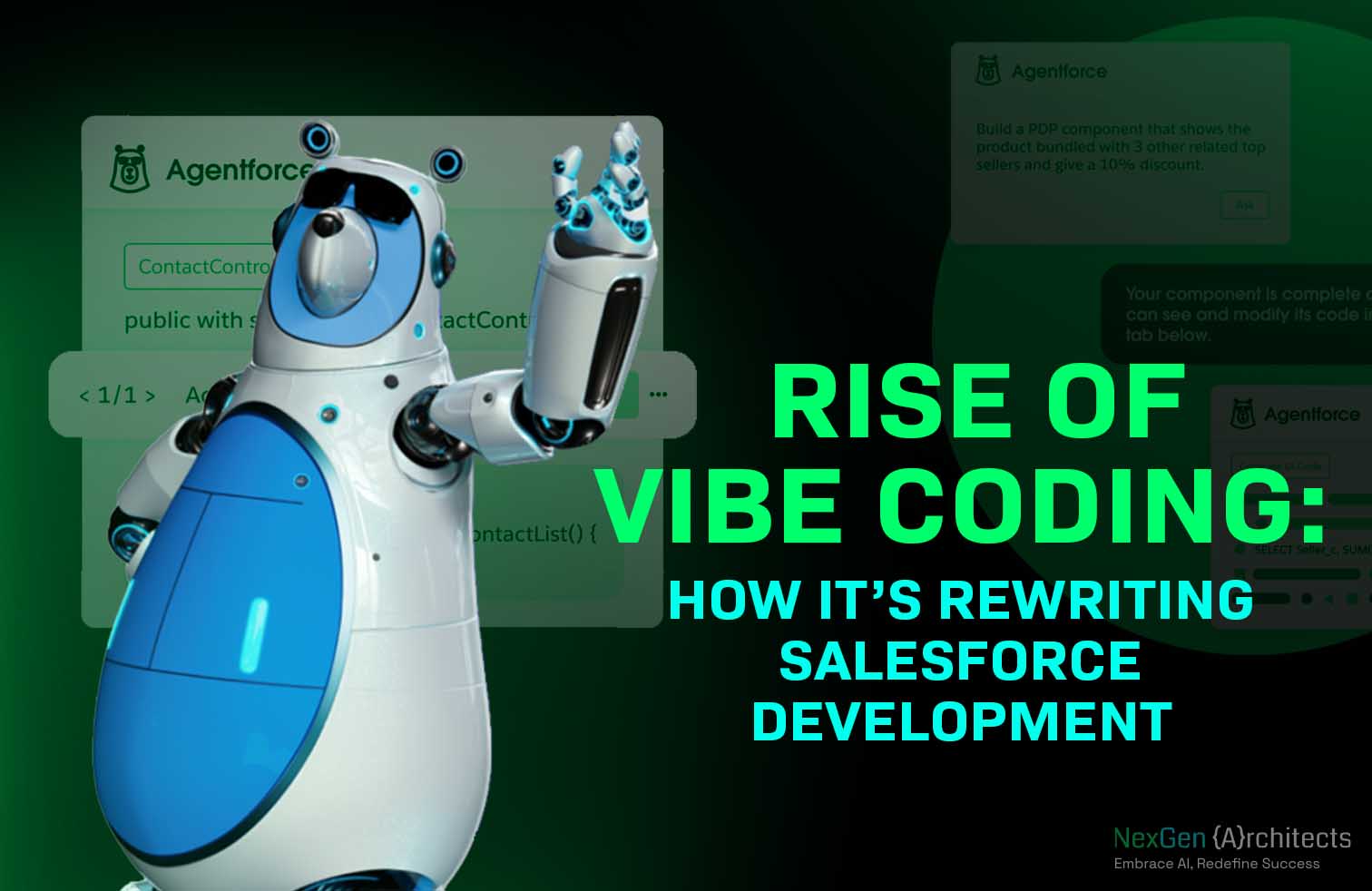
For years, Salesforce development followed a predictable rhythm. Requirements arrived in neat lines. Architects converted them into design documents. Developers translated those documents into Apex classes, flows, triggers, and metadata bundles. It was structured, methodical, and depending on who you asked comfortably slow.
Then AI arrived.
What started as autocomplete for code editors has quietly evolved into something else entirely: a new way of building software where the developer is no longer bound to the syntax of the system, but to the clarity of the idea. That shift is what many engineers are now calling vibe coding, a style of development where natural language becomes the entry point, AI becomes the partner, and the output is working Salesforce logic that emerges through conversation rather than construction.
And it’s changing far more than how code is written.
At first glance, the term “vibe coding” feels playful, almost unserious. But the shift it represents is one of the most consequential changes to enterprise development in a decade.
In classical development, you start with structure:
You move forward only when you’ve named everything, defined everything, and constrained everything. But vibe coding flips the sequence. Instead of beginning with rigid boundaries, you begin with intent.
You describe your requirements like:
“How should this approval process behave?”
“What should happen when a case escalates?”
“What does a flexible pricing engine need to evaluate?”
The AI generates the first working version. Then you refine, correct, reshape, and re-align it until it fits the outcome in your head.
The architecture still matters deeply. But the entry barrier to creation collapses. This is why vibe coding is spreading so fast inside Salesforce ecosystems: it gives developers the freedom to build before bureaucracy slows them down.
What separates vibe coding from mere “AI-assisted coding” is the workflow it enables. You are no longer dictating code line-by-line; you are shaping the system through conversation. In Salesforce, this applies to far more than Apex.
When a developer describes a LWC state change, the AI doesn’t just generate HTML and JS; it can infer data access patterns, recommended wire adapters, and even caching approaches.
When an architect describes a flow, the AI doesn’t simply create nodes; it can propose guardrails, loop handling, fault paths, and transactional decisions.
And when an admin outlines a business rule, the AI can draft the validation logic, the test scenarios, and the exception narrative.
What emerges is not a shortcut, but a new mental model for development:
You begin with language. The AI provides structure, the developer provides judgment. The final system is shaped almost sculpted into place.
The developer's job, ironically, becomes more complex and more strategic:
reviewing logic, ensuring alignment with architectural patterns, validating data assumptions, and reinforcing governance.
Vibe coding does not eliminate craftsmanship. It eliminates the dead time around craftsmanship.
Many assume vibe coding is a natural fit for AI-native environments. The surprise is that Salesforce, long considered configuration-heavy and opinionated, is where this shift may accelerate fastest.
There are three reasons.
Apex controllers, trigger frameworks, LWC scaffolding, flow orchestration patterns, even permission strategies; these have consistent shapes that AI models understand extremely well.
When you describe intent, the platform already has a structured way of expressing it: object attributes, relationships, actions, flows, and automations. AI doesn’t have to invent primitives; it only has to select and join them meaningfully.
Topics, instructions, and actions are not far from the essence of vibe coding. Agents respond to intent and salesforce agentforce help do it. Developers increasingly define intent instead of manually constructing every step.
Salesforce is quietly becoming the ecosystem where natural-language-driven development graduates from novelty to normal.
For over a decade, Salesforce architecture revolved around one classic debate:
Vibe coding dissolves the border.
A declarative builder can now describe logic that AI translates into a flow with correct branching and fault paths. A developer can describe a complex data pipeline and receive an Apex scaffolding that follows enterprise patterns.
The conversation becomes the bridge. Declarative thinkers gain programmatic superpowers. Programmatic developers accelerate past boilerplate straight to application logic. Architects shift from writing designs to explaining the mental model behind the design.
The platform becomes a shared language space rather than a split universe.
This is the right part enterprises are worrying about. If anyone can “vibe” an automation into existence, what keeps systems safe? What prevents accidental recursion loops, governor-limit violations, or runaway automations?
Ironically, vibe coding strengthens governance, if implemented correctly.
When developers begin with intent, the AI has the opportunity to enforce patterns before mistakes happen. Imagine a world where the platform itself says:
“This flow will cause transaction fragmentation.”
“This Apex design violates your trigger framework.”
“These queries risk hitting CPU limits.”
“This LWC lacks reactivity safeguards.”
Instead of governance being a review function, it becomes a companion function in the act of development.
This is where enterprises gain the most: vibe coding allows large Salesforce estates to maintain velocity without losing architectural discipline.
Every shift in development practice changes team structures. Vibe coding is no different.
It doesn’t remove roles, it sharpens them:
And perhaps most importantly: the gap between idea and implementation shrinks.
A product owner describing a feature in a meeting is not far from that feature’s first draft.
That compression of distance between thought and system behavior is where the next decade of Salesforce development is heading.
We are entering the post-syntax era of Salesforce development. When development becomes natural-language-first, the real differentiator is no longer who writes the cleanest Apex. It’s who understands the problem space, the business domain, the data relationships, and the architectural consequences.
It’s because syntax becomes automated, structure becomes recommended, and the intent becomes the source of truth.
Salesforce development is being rewritten less by tools, and more by how developers think when constraints are removed, and creativity is amplified.
Vibe coding is not a trend. It’s the early signal of a new development culture where language becomes the interface; AI becomes the collaborator, and architecture becomes the discipline that keeps everything aligned.
And for teams ready to embrace it, this is the closest we’ve come to unlocking true velocity in Salesforce delivery.
.svg)

