
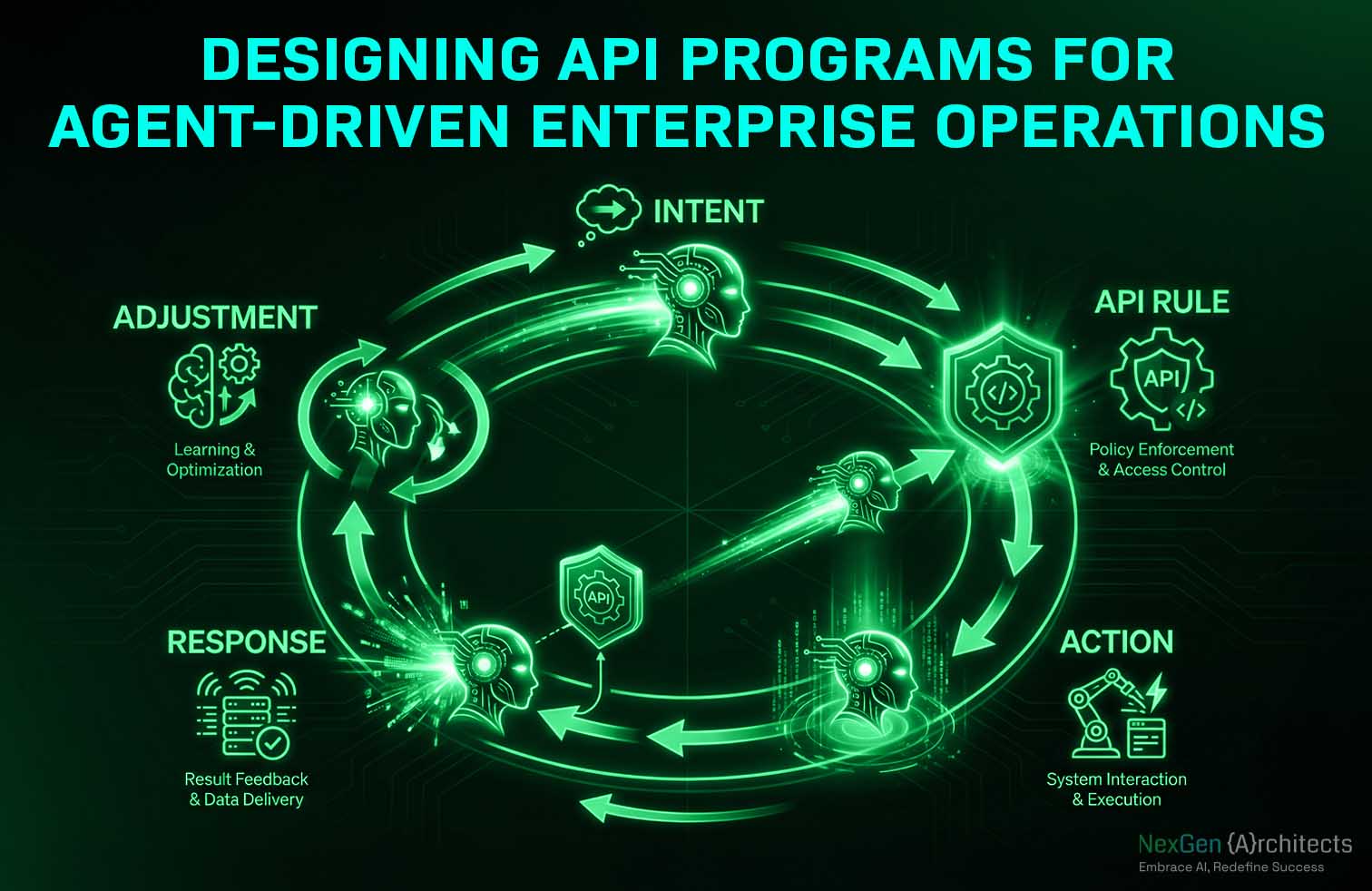
Most enterprises built their API programs during an era when consumers were predictable mobile apps, partner systems, internal applications, and human-triggered workflows. Every integration had a clear intent, and every API call happened within a controlled business process.
Autonomous agents change this foundation completely. They don’t follow predefined workflows, and they don’t wait for user input. They interpret goals, assemble their own sequence of actions, and interact with systems in ways traditional integrations never accounted for.
Designing an API program for this new environment is no longer an IT exercise. It becomes an operational strategy: how do you let intelligent systems act freely while maintaining discipline across your architecture?
Below is a practical view of how enterprises can rethink API programs for agent-driven operations not to limit autonomy, but to give it a safe structure.
API Programs Must Shift From Enabling Access to Shaping Behaviour
In the past, an API program’s success was measured by adoption: more APIs, more integrations, more consumers. With agents, the measure shifts from “How many can access the API?” to “How do we ensure every consumer behaves correctly?”
Agents operate with high variability. A single goal can result in many possible execution paths. Any of these paths may be technically valid but contextually wrong.
This is why API programs must evolve into something more than a catalogue of endpoints. They need to become a behavioural framework, where:
- APIs guide agents toward the right decisions
- System responses steer agents away from incorrect sequences
- Contracts prevent agents from improvising beyond defined boundaries
You’re not designing for transactions anymore; you’re designing for reasoning systems that learn and adapt.
Clarity in Intent Becomes More Important Than Completeness in Functionality
Traditional API design often emphasised complete coverage making every capability available, so consuming systems had maximum flexibility. But agents don’t need maximum flexibility. They need clearer boundaries and unambiguous signals.
This means APIs must be designed with:
- Explicit intent rather than broad capability
- Narrower endpoints that reduce decision ambiguity
- Responses that help agents understand state transitions
- Error messages that teach rather than merely reject
For example, instead of returning “Invalid request,” an enterprise-grade response might tell an agent:
- The rule it violated
- The next allowable action
- The limits of the operation
This prevents agents from drifting into unpredictable retry patterns or constructing flawed sequences.
Operational Constraints Must Be Expressed Directly in the API Design
When humans write integrations, they naturally adapt to constraints. Agents do not.
If a process must not be executed during certain hours, or certain fields cannot be updated in specific business conditions, the API needs to communicate that explicitly. These constraints can’t live in documents or tribal knowledge anymore; the API itself must enforce them.
Enterprises can embed such constraints into:
- Request validation rules
- Conditional business checks
- Version-level changes that reflect policy updates
- Response headers that signal permissible next steps
The goal is to make every API a faithful representation of the organization's business policy, not merely a technical interface.
Design for Variability Because Agents Don’t Call APIs the Same Way Twice
A common mistake in agent-era API design is assuming that agents behave like applications. They don’t.
Agents may:
- Call the same endpoint with slight variations to test outcomes
- Retry with modified parameters
- Explore optional fields to refine their internal model
- Request additional context because their reasoning loop demands it
API programs must therefore assume variability as a default condition. This requires:
- Stable contracts that allow exploration without breaking
- Lightweight optionality to support reasoning loops
- Predictable error structures that do not derail intent
- Throttling patterns that slow agents without blocking progress
The API design philosophy becomes less about restricting variability and more about absorbing it safely.
Lifecycle Management Matters More Because Agents Don’t Forget Old Paths
Humans adapt quickly when an API is deprecated or replaced. Agents, however, may continue calling older endpoints because:
- Their memory stores previous successful sequences
- Their reasoning loop assumes a certain path still exists
- Their training data contains historic patterns
- They optimise using past interactions, not documentation
This creates a scenario where outdated APIs become an operational risk.
Lifecycle management in an agentic environment must include:
- Version signalling that agents can interpret programmatically
- Grace periods where old and new behaviours coexist safely
- Deactivation responses that guide agents toward the correct path
- Deprecation warnings designed for machine consumption
The API becomes part of the adaptation mechanism, not just a change of log item.
Designing for Safe Failure Is Now a Core Architectural Principle
When a human encounters an error, they stop and investigate. Agents don’t. They try again, infer alternatives, or escalate actions.
This means failure states must be engineered with intent:
- Rate limits should degrade gracefully, not abruptly
- Errors should include alternative action hints
- Conflicts should guide correction rather than reject blindly
- Temporary issues should be communicated with retry-safe patterns
Agents rely heavily on feedback loops. Poorly designed failure responses can send them into loops, backtracking patterns, or unintended escalation. Good failure design keeps the agent stable even when systems are not.
Future API Program Is a Governance System
Enterprises adopting agents will eventually realise their API program is no longer a technical portfolio. It becomes the operational guardrail for machine-led work.
This requires a shift in mindset:
- APIs express business rules, not just data access
- API decisions are part of organisational policy
- API behaviours influence how agents learn and act
- API governance becomes the safety net for autonomous operations
Every endpoint is no longer a capability; it is a controlled action within a larger machine-driven workflow.
Closing Thoughts
Designing APIs for agent-driven operations forces enterprises to think differently. Instead of enabling broad consumption, the goal becomes providing clear behavioural boundaries and structured decision environments.
Autonomous agents bring new opportunities, but they also require APIs that can guide, inform, constrain, and stabilise their actions. The organisations that adapt their API programs to this new paradigm will be the ones that scale agentic automation safely and use it as a competitive advantage.

.svg)

