No items found.
AI
Jan 30, 2024

Learn how MuleSoft helps enterprises securely manage and govern API access for autonomous agents, ensuring controlled execution, visibility, compliance, and predictable b
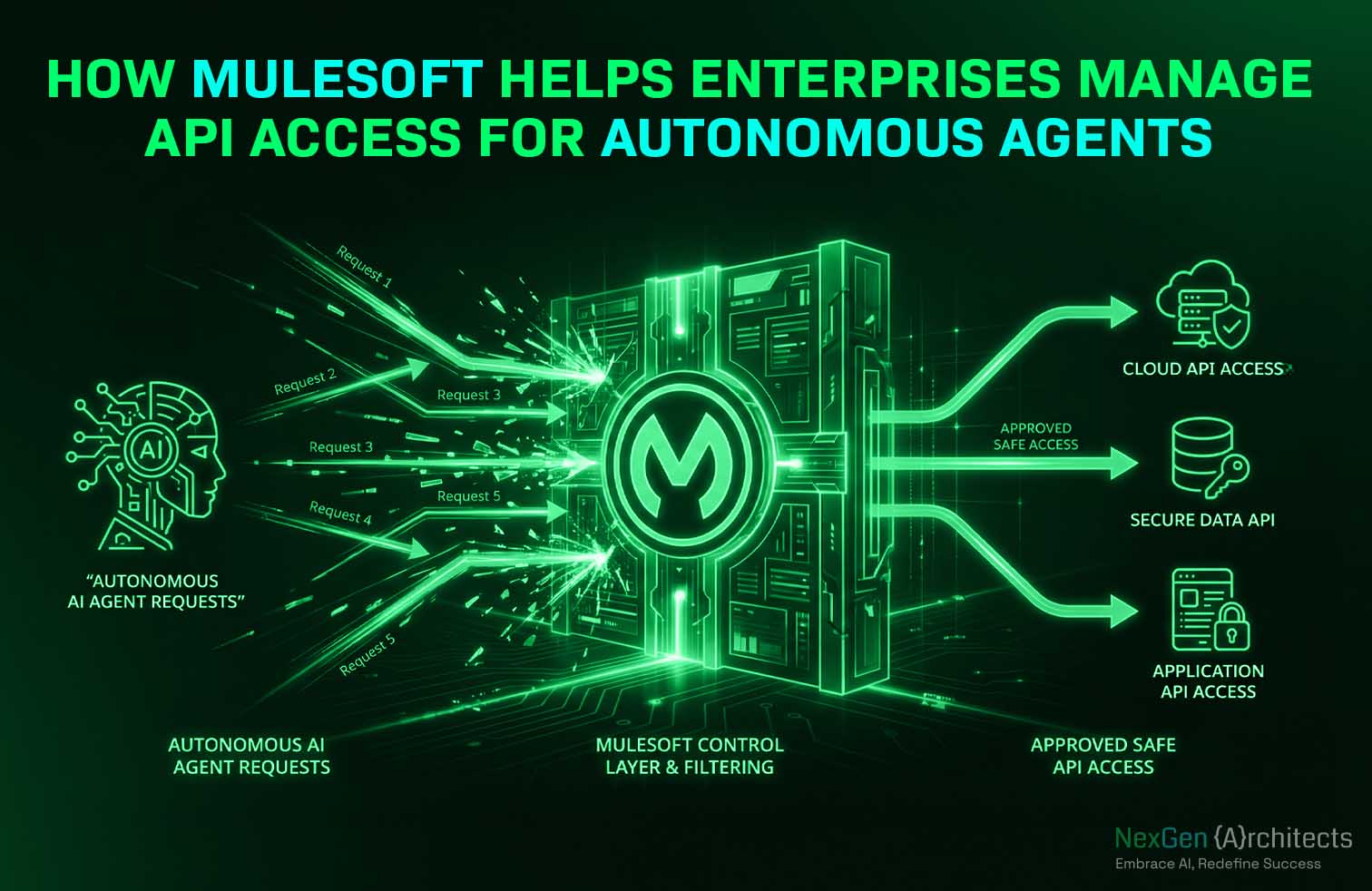
Enterprises are beginning to redesign how their systems operate because of a simple but powerful shift: autonomous agents are no longer experimental. They are starting to perform real work inside large organisations retrieving data, initiating updates, coordinating with multiple systems, and even chaining multi-step operations without human intervention.
This creates a completely different relationship between applications and APIs. Earlier, APIs were mostly “requested” by known systems in predictable workflows. Now, the consumer is an intelligent entity that interprets goals, converts them into actions, and interacts with systems in ways that cannot be pre-scripted. The question for enterprises becomes less about connectivity and more about control.
MuleSoft, intentionally or not, has evolved into the platform that provides that control. Not by adding new AI features, but through the discipline it already brings to API management the discipline enterprises now need before they let autonomous agents touch production systems.
When a human triggers a workflow, the organisation knows the intent. Even traditional automation like RPA follows fixed paths with little room for improvisation. Autonomous agents do neither. They create their own paths based on goals, system responses, or learned behaviours.
This flexibility introduces new risk conditions that traditional API programs were not designed for:
These are not malicious scenarios; they are simply side effects of giving a machine the ability to think and act. APIs need a structural way to anticipate and regulate this behaviour without sacrificing the benefits that autonomous agents bring.
Many people think MuleSoft is only about system connectivity. In practice, its most valuable function in an agentic environment is that it becomes the decision boundary between “what the agent wants to do” and “what the organisation permits.”
MuleSoft enforces this through mechanisms that operate deeper than surface-level authentication. These mechanisms allow enterprises to create rules that apply universally, regardless of whether the API consumer is a system, a human, or an autonomous agent.
Instead of agents interacting directly with applications, they interact with APIs that are always mediated by MuleSoft. This means every request is evaluated against enterprise-defined conditions. These conditions are not expressed as checklists but as operational principles, such as:
These rules shape the agent’s permitted behaviour. They do not prevent intelligent action, but they create boundaries the agent cannot cross or test.
One of the most important roles MuleSoft plays is enforcing predictability. Humans working with agents expect speed and autonomy; security teams expect repeatability and oversight. MuleSoft becomes the layer that slows an agent when required, blocks it when necessary, and records everything it does.
This helps prevent behaviours such as:
Enterprises gain the benefits of agent autonomy without exposing their systems to uncontrolled execution.
When agents start making decisions, enterprises need full visibility into what those decisions resulted in. MuleSoft already has the instrumentation to answer questions that were never relevant in the pre-agent era:
This visibility is not analytics; it is operational context.
It ensures that even when a machine initiates an action, humans can understand the path it followed.
Most enterprises underestimate how much this matters until an agent behaves unexpectedly and someone needs to trace the chain of decisions.
Autonomous agents become truly useful only when they can act, not merely observe. But taking action inside enterprise systems is where the risks multiply. MuleSoft helps reduce this risk by turning every API call into a governed transaction rather than a free-form action.
What this enables is essential for safe agent execution:
Without MuleSoft, the only thing standing between an autonomous agent and core business systems would be the agent’s reasoning model and no enterprise CIO is willing to rely on that alone.
The next evolution of enterprise automation is not more scripts or workflows. It’s intelligent actors interacting with business systems as if they were part of the organisation themselves.
MuleSoft is not competing with agents; it is giving enterprises a way to adopt them safely. As more teams start using agents for tasks like reconciliation, case resolution, data preparation, or employee provisioning, the importance of a controlled API layer increases.
Enterprises that try to skip this will find themselves dealing with unpredictable system interactions, unclear audit trails, and compliance challenges they did not anticipate.
Autonomous agents unlock enormous operational potential, but they introduce uncertainties that enterprises cannot afford to ignore. MuleSoft provides a structural answer to these uncertainties by turning the API layer into a governed space where intelligent systems can operate without risking integrity, security, or compliance.
As agentic workflows expand, the organisations that succeed will be the ones that treat the API layer not simply as infrastructure, but as the control environment their agents rely on.
.svg)

