No items found.
AI
Jan 30, 2024

Discover how Salesforce Data Cloud for Financial Services drives real-time ROI, hyper-personalization, and competitive advantage in the BFSI sector.
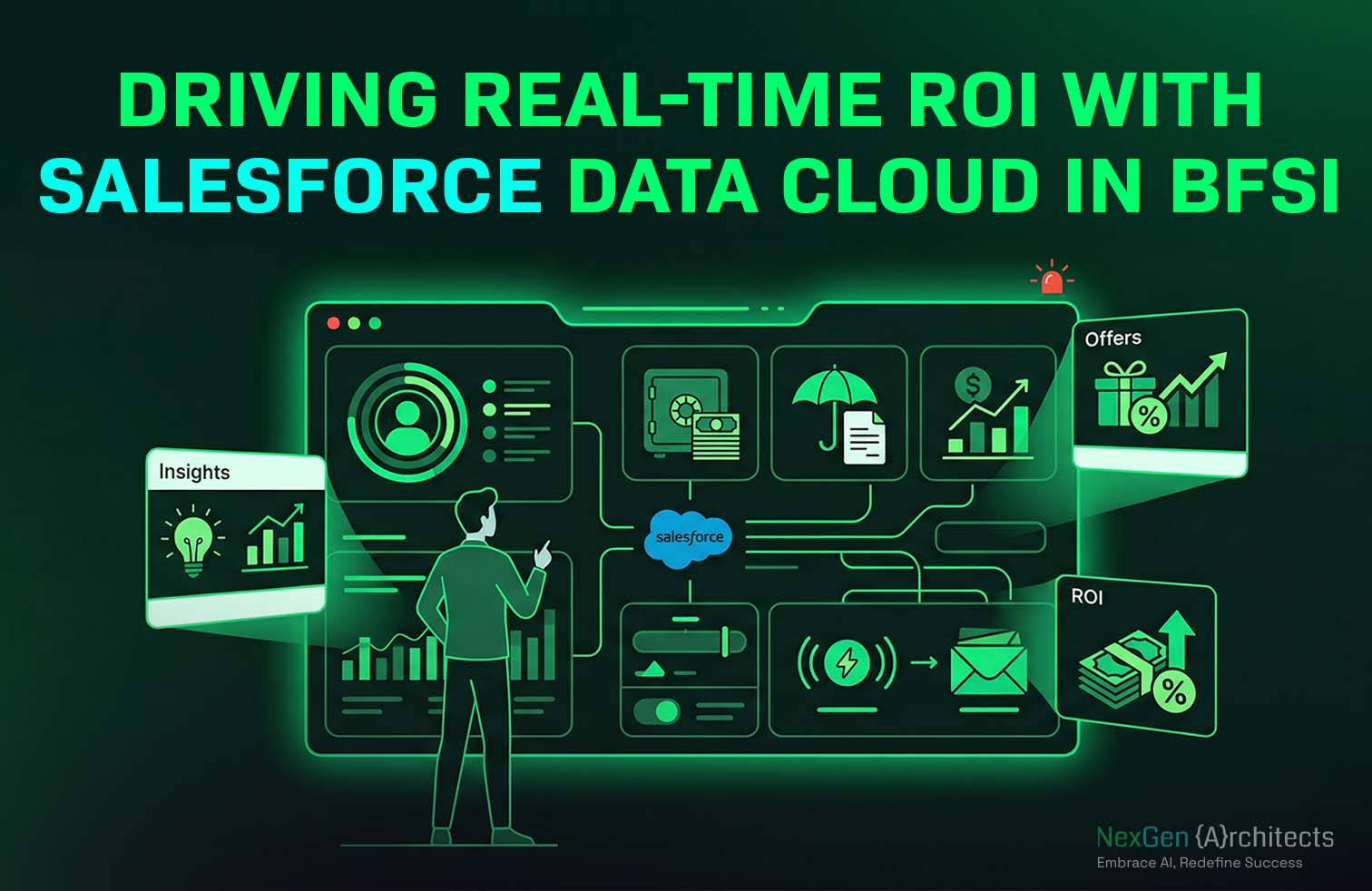
Financial institutions face increasing pressure to deliver personalized experiences while navigating complex regulatory landscapes. Disparate data sources, legacy systems, and a lack of real-time insights often hinder efforts to understand customer needs and respond effectively. This fragmentation not only impacts customer satisfaction but also limits opportunities for revenue growth. The ability to consolidate, analyze, and act on customer data in real time is no longer a luxury but a necessity for competitive advantage.
Here we explore how Salesforce Data Cloud for Financial Services addresses these challenges, enabling institutions to drive real-time ROI through enhanced customer experience, engagement and operational efficiency. We will delve into its architecture, implementation strategies, and the tangible benefits it offers to the BFSI sector.
Salesforce Data Cloud unifies customer data from various sources into a single, comprehensive profile, allowing financial institutions to understand individual customer behaviors, preferences, and needs in real time. This unified view empowers them to deliver highly relevant and timely interactions across all touchpoints, from personalized product recommendations to proactive service offerings, thereby fostering deeper customer relationships and driving engagement at an unprecedented scale.
The core strength of Salesforce Data Cloud lies in its ability to ingest, harmonize, and activate data from across the entire enterprise. This includes:
By consolidating these diverse datasets, financial institutions gain a holistic view of each customer. This unified profile is continuously updated in real time, ensuring that every interaction is informed by the most current information available.
For example, if a customer browses a specific loan product on a banking app, the Data Cloud can immediately trigger a personalized offer or a follow-up communication through their preferred channel. This level of responsiveness is crucial in a fast-paced financial market where customer expectations for instant gratification are high.

Implementing Salesforce Data Cloud for Financial Services requires a well-defined architecture that prioritizes data ingestion, harmonization, and activation.
The process begins with identifying all relevant data sources, which can range from core banking systems and CRM platforms to marketing automation tools and customer service portals. Data Cloud uses a robust set of connectors and APIs to ingest this data, often in a streaming fashion, ensuring that information is always current.
Once ingested, the data undergoes a harmonization process where it is standardized, cleansed, and de-duplicated. This is critical for creating accurate and reliable customer profiles. Identity resolution, a key feature of Data Cloud, links disparate records belonging to the same individual, forming a single customer view.
This unified profile then becomes the foundation for segmentation and activation. Financial institutions can define granular customer segments based on a multitude of attributes, including:
These segments are dynamic, updating automatically as customer behavior evolves.
The activation phase involves pushing these enriched customer profiles and segments to various downstream systems, including marketing clouds, sales platforms, and service consoles. This ensures that every customer-facing application has access to the same real-time insights, enabling consistent and personalized experiences across all channels.
For instance, a customer service representative can see a customer's recent interactions, product interests, and even their propensity to churn, allowing them to provide more empathetic and effective support.
The tangible benefits of a well-implemented Salesforce Data Cloud strategy are significant, particularly in the BFSI sector. Financial institutions have seen impressive results with Salesforce, achieving a 188% ROI boost and a 15–45% increase in cross-sell and upsell opportunities, according to Grazitti. This demonstrates the direct correlation between unified data, hyper-personalization, and revenue growth.
.jpg)
The ability to identify and act on cross-sell and upsell opportunities in real time is a major driver of this ROI. For example, if a customer opens a new checking account, Data Cloud can identify other complementary products they might need, such as:
These recommendations can be delivered through targeted email campaigns, in-app notifications, or even directly to a financial advisor for a personalized outreach.
This proactive approach not only increases revenue but also deepens customer relationships by demonstrating an understanding of their evolving financial needs. Furthermore, by personalizing marketing messages and product offerings, institutions can reduce customer acquisition costs and improve the efficiency of their marketing spend.
Successful Salesforce Data Cloud implementation strategies involve a phased approach, starting with a clear understanding of business objectives and desired outcomes.
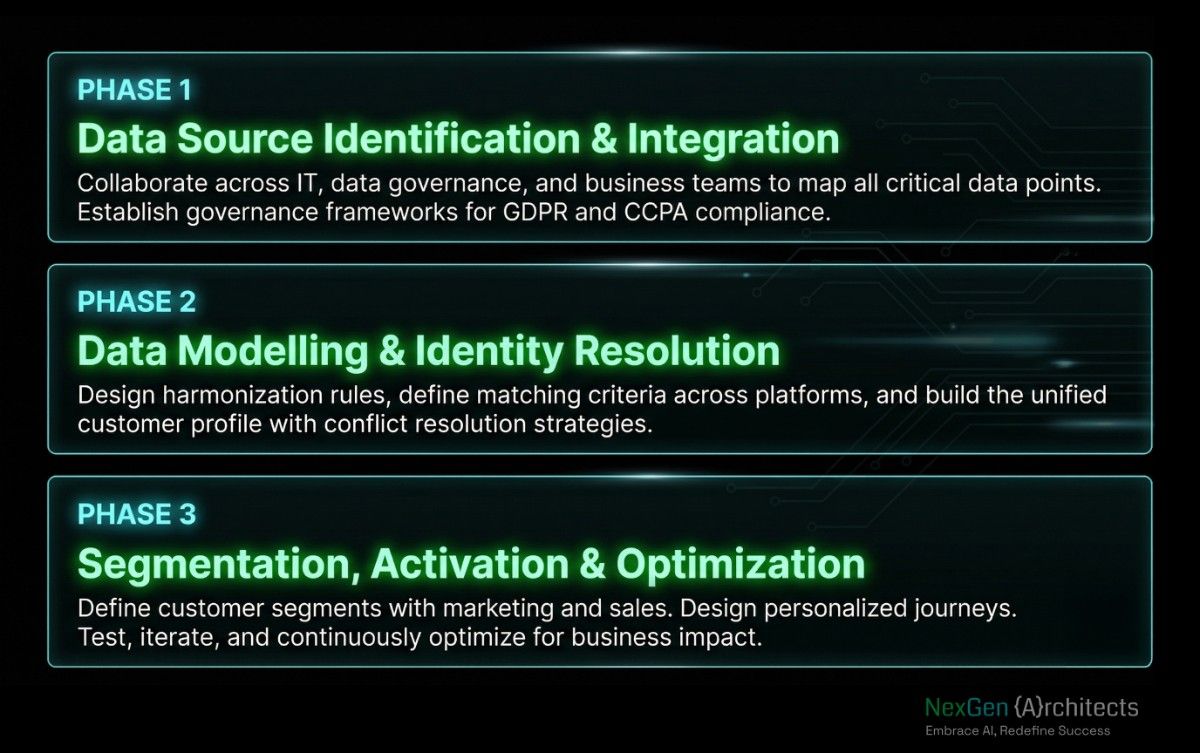
The initial phase focuses on data source identification and integration. This requires collaboration between IT, data governance, and business stakeholders to ensure all critical data points are captured and accurately mapped. A robust data governance framework is essential to maintain data quality, privacy, and compliance with regulations such as GDPR and CCPA.
The next phase involves defining data models and identity resolution rules. This is where the architecture team designs how data from different sources will be harmonized into a unified customer profile. Careful consideration must be given to:
Once the data model is established, the focus shifts to segmentation and activation. This involves working with marketing and sales teams to define relevant customer segments and design personalized journeys.
Testing and iteration are crucial throughout this process to optimize the effectiveness of personalization efforts. Finally, continuous monitoring and optimization are necessary to ensure the Data Cloud continues to deliver value and adapt to changing business needs.
The financial services industry operates under stringent regulatory requirements, making data privacy and security paramount. Salesforce Data Cloud is designed with these considerations in mind. It provides robust security features, including:
Furthermore, its ability to centralize data simplifies compliance efforts by providing a single, auditable source of truth for customer information.
By having a consolidated view of customer data, financial institutions can more easily demonstrate compliance with data privacy regulations. They can:
The platform's capabilities for data lineage and transparency also assist in demonstrating accountability and adherence to industry-specific regulations, reducing the risk of non-compliance and associated penalties. This not only protects the institution but also builds trust with customers who are increasingly concerned about how their personal financial data is handled.

The ability to harness real-time customer data is transforming the financial services landscape, driving both operational efficiency and significant revenue growth. Salesforce Data Cloud for Financial Services provides the foundational technology to achieve this, enabling institutions to move beyond fragmented data to deliver hyper-personalized experiences at scale. By unifying customer data, streamlining operations, and empowering data-driven decision-making, financial institutions can unlock substantial ROI and secure a competitive edge.
Our Salesforce Data Cloud Consulting services help BFSI firms unlock the power of their data, driving revenue growth through targeted, real-time customer experience.
.svg)

