No items found.
Salesforce
Jan 30, 2024

An overview of Anypoint Flex Gateway, its architecture, governance model, limitations of centralized gateways, and real enterprise implementation patterns.
.jpg)
Most API gateway architectures were designed for a time when APIs entered and exited the enterprise through a small number of controlled network points. Traffic flowed north–south; deployments were relatively static, and enforcing policy at a single ingress was sufficient.
That model no longer reflects how enterprises operate.
Today, APIs are deployed across Kubernetes clusters, cloud platforms, SaaS applications, partner environments, and regional data centers. They are consumed not only by internal applications and partners, but increasingly by automated systems and AI agents. In this environment, forcing all traffic through a centralized gateway introduces latency, fragility, and operational coupling that enterprises struggle to sustain.
Anypoint Flex Gateway was introduced to address this architectural mismatch. Its purpose is not to simplify API management, but to make governance compatible with distribution.
Anypoint Flex Gateway is a cloud-native API gateway runtime that can be deployed alongside APIs wherever they run on Kubernetes, virtual machines, cloud infrastructure, or on-premise environments. While the runtime executes locally, its policies, configuration, and analytics are managed centrally through the Anypoint Platform.
This design allows enterprises to apply consistent API governance without requiring APIs to be redeployed, rehosted, or routed through a central ingress.
Flex Gateway operates as part of the Anypoint Platform from MuleSoft, which itself sits within the broader enterprise platform ecosystem of Salesforce.
Modern enterprises cannot enforce API governance by centralizing traffic without creating new risks.
API traffic follows system architecture, not governance preferences.
In large organizations, APIs are often exposed directly from:
When governance requires traffic to be rerouted through a central gateway, teams face a choice: accept performance degradation or bypass governance entirely. In practice, many choose the latter, leading to inconsistent security enforcement and limited visibility.
Flex Gateway removes this dilemma by allowing policy enforcement to occur at the point of execution, rather than at a distant control point.
Enterprise platform teams are responsible for security, compliance, and auditability. Application teams are responsible for delivering features quickly and reliably. When API governance is tightly coupled to deployment pipelines or network routing, it becomes a blocker rather than an enabler.
The result is predictable:
Flex Gateway separates governance decisions from deployment mechanics. Policies are defined centrally, but enforcement does not require changes to application code or infrastructure pipelines.
Zero Trust architectures are built on the principle that no request should be trusted by default, regardless of its origin. In traditional gateway models, trust is often established once at the perimeter. Internal API calls are then implicitly trusted, even though they may traverse multiple systems and domains.
In distributed environments, this assumption creates blind spots. A compromised internal service can call downstream APIs without revalidation, and perimeter controls offer no protection.
Flex Gateway enables identity, authorization, and policy checks to occur at each API boundary, ensuring that trust is evaluated consistently throughout the system.
Legacy gateway models were built for static networks and predictable consumers.
As API volume increases, centralized gateways become:
These issues are not configuration problems. They are consequences of an architecture that assumes centralization is desirable.
Service meshes are effective for managing retries, timeouts, and mutual TLS between services. However, they do not understand API contracts, business-level authorization, or consumption policies. They are designed for transport-level concerns, not governance.
Flex Gateway operates at a different layer, enforcing API-specific policies that service meshes are not designed to handle.
Some organizations build custom gateways using Envoy or NGINX. While this offers flexibility, it often results in:
Flex Gateway standardizes governance without forcing teams into a single deployment model.
Flex Gateway decouples policy control from runtime execution by design.
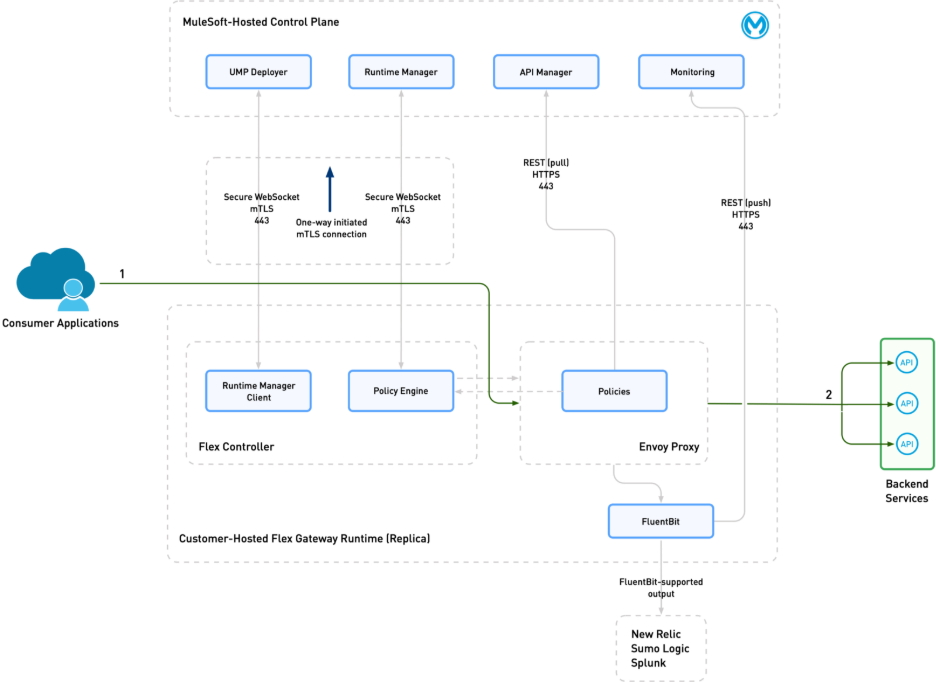
The Anypoint control plane is responsible for defining policies, managing API registrations, and aggregating analytics. Flex Gateway runtimes act as distributed data planes that enforce these policies locally, where API traffic actually flows.
This separation allows enterprises to scale API deployments independently of governance operations, reducing coupling and operational friction.
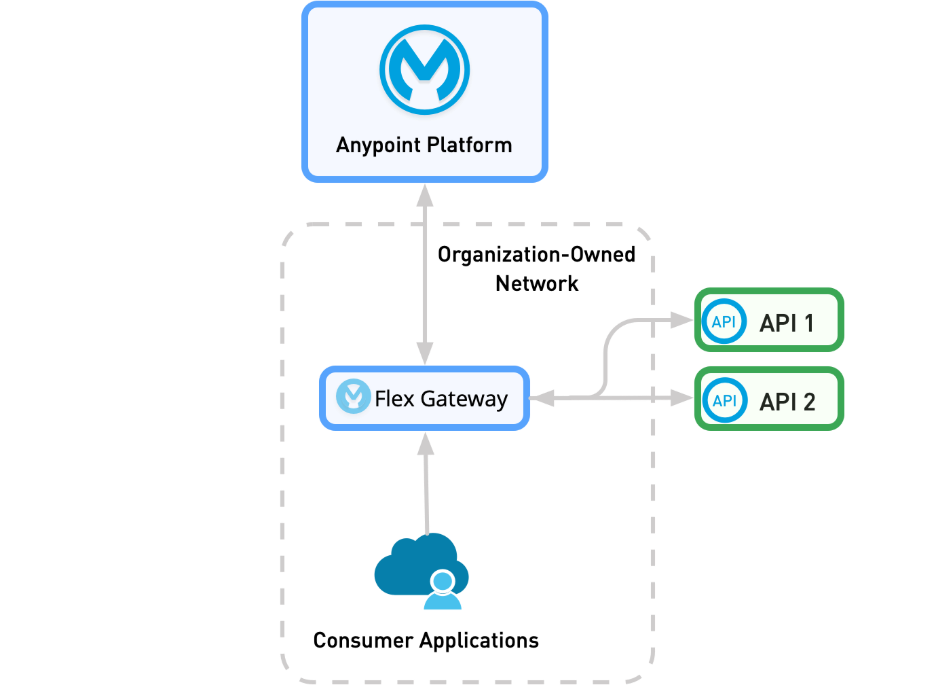
Flex Gateway adapts to existing infrastructure instead of reshaping it.
Flex Gateway can be deployed:
There is no requirement to use Runtime Fabric or CloudHub, which allows teams to adopt Flex Gateway incrementally.
In short,
What Problem Does Flex Gateway Solve
Flex Gateway allows enterprises to enforce security, traffic management, and observability policies regardless of where APIs are deployed, eliminating the need to compromise between governance and performance.
Why Existing Approaches Fail
Centralized gateways assume predictable traffic paths, static infrastructure, and perimeter-based trust. Distributed, hybrid, and agent-driven architectures violate all three assumptions, making traditional models ineffective.
How Leading Enterprises Implement Flex Gateway
Successful adoption reflects architectural maturity rather than tool usage.
Distributed Enforcement with Central Governance
Enterprises deploy Flex Gateway close to APIs, often per domain or workload, while managing policies centrally. This ensures consistent enforcement without introducing deployment dependencies between teams.
Incremental Policy Adoption
Rather than enforcing all policies at once, organizations typically begin with authentication and authorization, then introduce rate limiting, threat protection, and analytics over time. This reduces risk during rollout.
Governing Autonomous and Agent-Driven Traffic
As AI agents begin invoking APIs independently, traffic patterns become less predictable. Flex Gateway provides the enforcement layer needed to control agent behavior, enforce quotas, and maintain auditability.
Common Implementation Mistakes
Flex Gateway fails when treated as a tactical add-on rather than an architectural component.
Common issues include:
These mistakes negate the benefits of a distributed governance model.
Anypoint Flex Gateway represents a structural shift in how enterprises govern APIs. It reflects an acknowledgment that enterprise systems are inherently distributed, and that governance must adapt accordingly.
By separating control from execution, Flex Gateway enables organizations to maintain security, consistency, and visibility without re-centralizing systems that have already moved beyond that model.
.svg)

