No items found.
AI
Jan 30, 2024

Learn how API-led connectivity enables enterprise-scale autonomous agents with system, process, and experience APIs for secure, governed, and real-time AI orchestration.
Enterprises are moving from isolated automation to intelligent systems that can reason, act, and improve on their own. Autonomous agents are at the center of this shift, but their real value doesn’t come from how smart they are. It comes from how well they are connected.
Without reliable access to data, processes, and events across the organisation, even the most advanced agent becomes another siloed tool. This is where API-led connectivity provides the architectural backbone for scaling autonomous agents safely and predictably.
Over the last few years, organisations have adopted AI to automate tasks, assist teams, and streamline workflows. But as data volumes increase and operations become more distributed, traditional point-to-point integrations break down.
Autonomous agents need more than simple data access. They need context, governed pathways, and the ability to orchestrate actions across systems without creating operational risk.
API-led connectivity solves this by introducing a structured way of exposing systems and business logic through reusable, composable APIs. Instead of every agent talking directly to every system, they interact with well-defined interfaces that ensure consistency and control.
Most early AI deployments hit the same roadblocks:
These issues are architectural. The agent may be capable, but the environment limits it.
API-led connectivity removes these constraints by separating systems, business logic, and experiences into structured layers. Each layer becomes a controlled pathway where data is standardised, logic is governed, and actions are traceable.
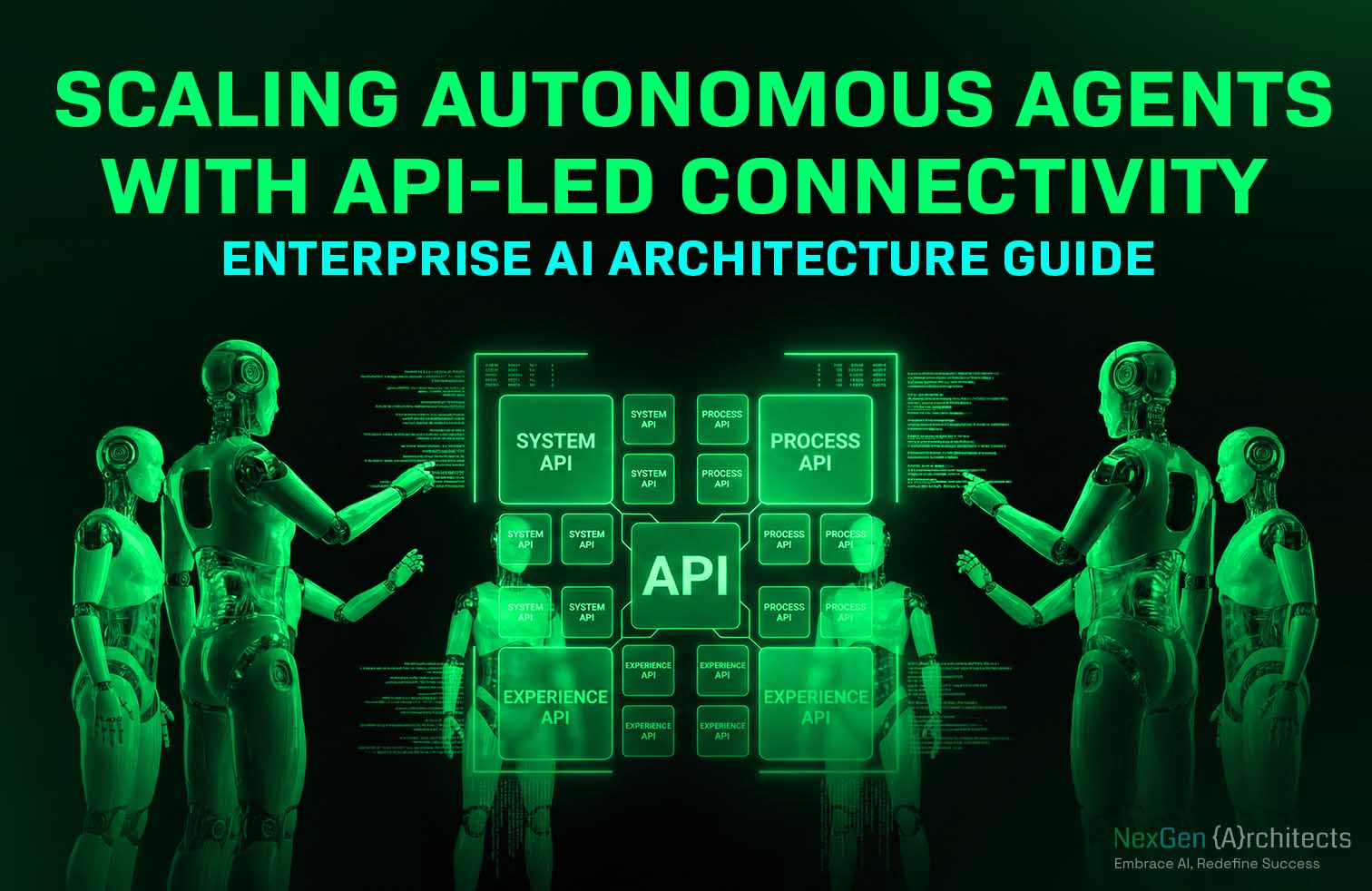
By organising data and actions into governed layers, API-led connectivity gives autonomous agents a predictable environment to work in. Here’s how each API layer works and how it shapes the reliability and safety of every autonomous action that follows.
System APIs standardise how core applications expose data and capabilities.
For agents, this means:
Instead of learning ten different system behaviours, agents consume a stable interface that behaves the same way every time.
Process APIs sit above system APIs and combine data from multiple systems.
They give agents a unified view of a business process, such as:
This is where an autonomous agent can make decisions and trigger multi-step actions without manually stitching systems together. Process APIs let agents focus on what needs to be done, not how to do it.
Experience APIs tailor information and actions for specific teams, regions, or channels.
For instance:
This ensures the same agent ecosystem can support multiple departments without re-engineering the underlying logic.
API-led connectivity allows enterprises to scale agents horizontally (across teams) and vertically (across processes) without creating operational chaos.
With proper governance, every agent follows the same rules, consumes the same data, and executes actions through the same secured pathways.
This unlocks capabilities such as:
Instead of building an agent per department, organisations create a common platform where agents “plug into” existing business capabilities.
As enterprises adopt reasoning engines, agent brokers, AI meshes, and autonomous workflows, the integration layer becomes more important than the AI layer.
Agents will continue to get smarter, but their success will still depend on how well they orchestrate across the digital landscape.
API-led connectivity provides:
For leaders planning their AI roadmap, the lesson is clear: you cannot scale agents without an architecture built to support them.
Autonomous intelligence doesn’t stand alone; it sits on top of a connected, governed, and composable enterprise.
If you want to turn autonomous agents into measurable business outcomes, we’d be glad to help you design a scalable, API-led foundation. Connect with us to get started.
.svg)

