No items found.
AI
Jan 30, 2024

Learn how integrating Einstein Enhanced Bots with Agentforce agents creates a scalable hybrid service architecture that balances speed, cost, and AI-driven intelligence.
Most service organizations already use some form of automation. Chatbots answer FAQs, check order status, log cases, or route conversations. These tools have helped reduce volumes and improve response times, but they also have clear limits. As soon as a customer’s request becomes nuanced, emotional, or multi-step, traditional bots start to struggle.
Salesforce’s introduction of Agentforce changes what’s possible from it. Agentforce agents can reason, maintain context, and take actions across systems. But that doesn’t mean existing Einstein Enhanced Bots suddenly become obsolete. In fact, the strongest service architectures today combine both Einstein bot and Agentforce.
Here we will explain how and why Einstein Enhanced Bots and Agentforce agents work best together, and what enterprises gain by designing a hybrid model instead of choosing one over the other.
Einstein Enhanced Bots are optimized for speed and predictability. They follow defined paths, enforce compliance, and handle high-volume, repetitive interactions with near-zero latency. For many service use cases, that’s exactly what’s needed.
Agentforce agents solve a different problem. They are designed for situations where:
Trying to make bots handle these scenarios often leads to brittle flows and poor experiences. Routing everything directly to Agentforce, on the other hand, can increase costs and reduce efficiency. The hybrid model avoids both extremes.
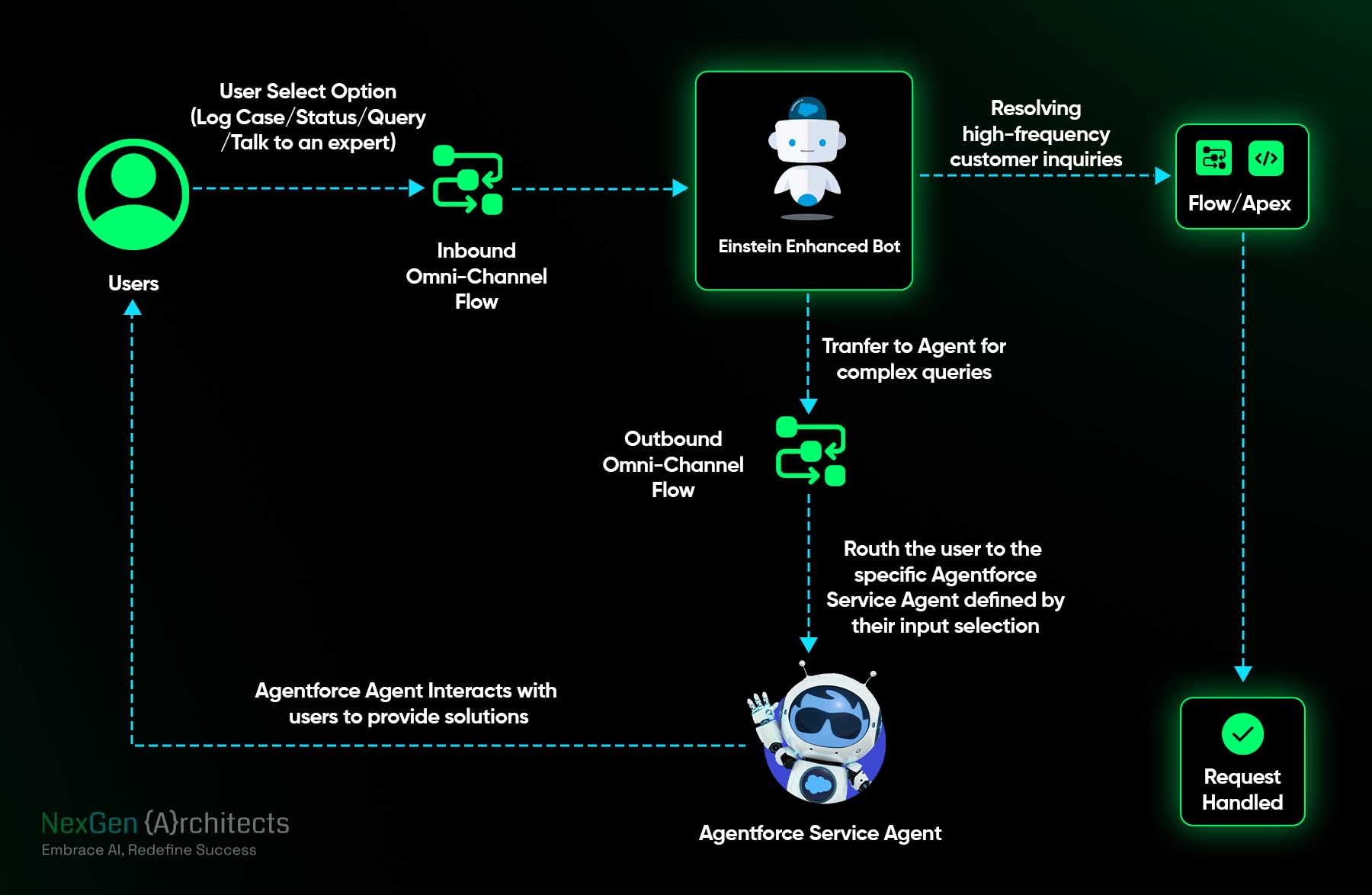
In a well-designed setup, the Einstein Enhanced Bot acts as the entry point and traffic controller. It greets users, resolves straightforward requests, verifies information, and identifies intent early in the conversation.
When the interaction requires deeper reasoning or action, the bot hands the conversation to an Agentforce Service agent that is purpose-built for that domain, such as billing, technical support, or general inquiries.
To the customer, this feels like one continuous experience. Behind the scenes, it’s a deliberate separation of responsibilities.
The success of this architecture depends less on the transfer mechanism and more on context preservation.
A common failure in bot-to-agent designs is asking the customer to repeat information they already provided. This breaks trust immediately. The way to avoid this is to treat intent as persistent data, but not a temporary chat variable.
By capturing intent during the bot conversation and storing it on the Messaging Session, the system ensures that downstream routing and Agentforce agents inherit the full context. Omni-Channel flows can then route work intelligently without re-questioning the user.
This single design choice turns a simple transfer into a seamless experience.
Agentforce is most effective when agents are specialized rather than generic. A billing-focused agent grounded in invoices and payment policies will outperform a one-size-fits-all assistant. The same is true for technical support or policy-driven inquiries.
Intent-based routing enables this specialization. Once intent is known and persisted, Omni-Channel can direct the conversation to the correct Agentforce agent, with fallback queues in place for resilience.
The result is faster resolution, higher accuracy, and clearer governance boundaries.
AI adoption in service is rarely blocked by capability alone. It’s blocked by trust.
Salesforce’s own UX research shows that users adopt AI faster when:
The hybrid bot-agent model supports this naturally. Bots handle deterministic tasks transparently. Agentforce agents surface reasoning, recommendations, and actions inside the flow of work. Nothing feels hidden or unpredictable.
When users understand why the system behaves the way it does, confidence builds over time.
Beyond experience and accuracy, the hybrid architecture delivers practical business benefits.
Routine, high-volume interactions remain in the Einstein Enhanced Bot layer, keeping costs low and performance high. Agentforce is reserved for interactions where its reasoning and autonomy create real value.
This reduces unnecessary AI consumption, optimizes Flex Credit usage, and allows teams to scale automation responsibly instead of all at once.
It also provides a safer adoption path. Organizations can expand Agentforce usage gradually, use case by use case, without disrupting existing service operations.
A Realistic Path from Bots to Agents
Salesforce’s roadmap reflects how enterprises actually adopt AI. Tools like Create Agent from Bot reinforce the idea that bots and agents can coexist during the transition. Bots remain active while Agentforce agents are introduced, refined, and scaled.
This avoids rip-and-replace strategies and protects prior investments, while still enabling organizations to move toward more intelligent, autonomous service models.
Designing service experiences that scale isn’t about choosing the newest AI capability. It’s about making thoughtful decisions on where intelligence belongs, how context flows, and how trust is maintained as automation increases. When Einstein Enhanced Bots and Agentforce agents are integrated deliberately, service teams get the best of both worlds: speed where predictability matters and reasoning where complexity demands it.
For organizations navigating this transition, the most important work often happens behind the scenes in architecture choices, routing logic, and governance models that determine whether AI feels helpful or disruptive. Teams that take the time to get this right tend to move faster later, with fewer reversals and less friction.
If you’re exploring how a hybrid bot–agent model could fit into your service landscape, it’s often useful to validate those design choices against real-world constraints before scaling further. Conversations grounded in actual workflows, data boundaries, and cost models tend to surface insights that no product documentation ever will.
.svg)

