No items found.
AI
Jan 30, 2024

We built a ServiceNow connector for Salesforce in days, not months. Generated with MuleSoft Connector Builder, delivered on hapie.ai, security review passed.

Every enterprise pays a tax it never agreed to: the gap between the systems that run the business.
Salesforce holds the data. ServiceNow runs the operations. And the two barely speak. So teams lose their days moving information between screens and reconciling numbers that should have matched on their own. The cost never lands on a budget line, which is precisely why nobody ever fixes it.
Most firms look at that gap and see a project. A discovery phase. A build phase. A quote measured in months. We look at it and see a problem that should already be solved.

NexGen Architects is an AI-powered service integrator, specialised in Salesforce, Agentforce and MuleSoft integrations. We are not generalists and we do not sell hours. We sell delivered outcomes, and we are built to move at a speed the traditional model cannot match.
Our edge is Hapie: the world's first Agentic Delivery Lifecycle Platform. Inside Hapie, more than two hundred specialised AI agents collaborate to carry a program from the first conversation to a governed, tested, shipped result. Discovery, specification, build, governance, deployment and validation run as one continuous pipeline, with our people holding judgment at every gate.
Put those two together and you get something the market has not seen. Not a consultancy with an AI tool bolted on. Not a platform searching for a services arm. A single delivery force where the expertise and the engine were designed for each other. That is the collaboration we are taking to market, and the numbers speak for themselves.

Where most systems integrators quote months for a project, we deliver a better outcome in half the time and half the budget. That is not a promise. It is our operating model.
NexGen Architects
We could tell you this works. Instead, we shipped it. The NexGen Architects ServiceNow Connector is live on Salesforce AppExchange today.
It gives teams a clean, governed bridge between Salesforce and ServiceNow. Records, incidents and workflow move between the two platforms reliably and in real time, with no hand coded glue in the middle. It is configured rather than programmed, so the people closest to the process can stand up what they need, with the security and governance an enterprise expects built in from the very first step.
It is not a bespoke project trapped inside one customer's org. It is a supported, versioned product that any organization can install. That distinction is the whole point, and it is what our delivery model makes possible.

Credibility lives in the detail, so here is exactly how the connector came together.
The connector itself was developed using MuleSoft Connector Builder. Building a production grade connector used to be one of the hardest things a services firm could take on. With Connector Builder, the work was closer to describing what we wanted than hand assembling every piece. It supported the key use cases directly: defining the ServiceNow operations that matter most, creating and updating incidents, keeping case and record data in sync, and moving workflow state between the two platforms. Just as important, it kept the result aligned to MuleSoft's own standards rather than to one developer's habits.
Everything around that build ran through Hapie. And that is where the time and the budget disappear on a traditional project.
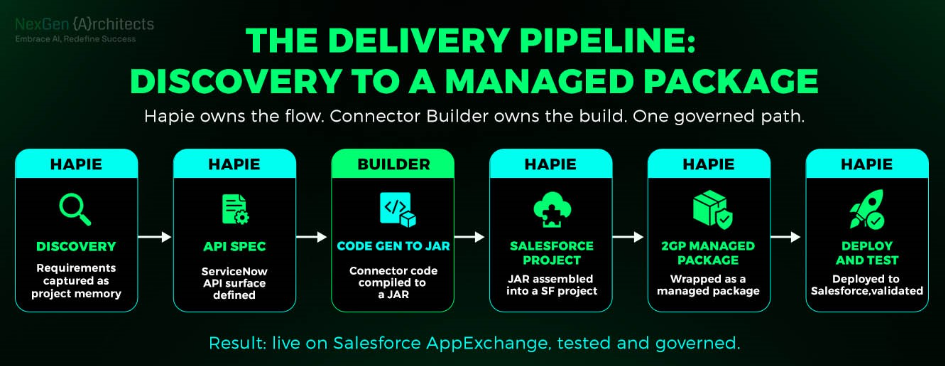
One governed pipeline, from a first conversation to a live AppExchange listing. No handoffs lost between teams. No review stall between build and release. No maintenance orphan left behind.
Here is what makes the speed repeatable rather than lucky. Inside Hapie, delivery is not one model writing code. It is a coordinated system of specialised agents, each responsible for a part of the lifecycle, sharing the same project memory and passing work through human judgment gates.
Requirements, architecture, data modelling, API design, build, quality assurance, security review, documentation, deployment and post release validation. Each has an agent. All of them collaborate. None of them ships anything past a gate without a person signing off.
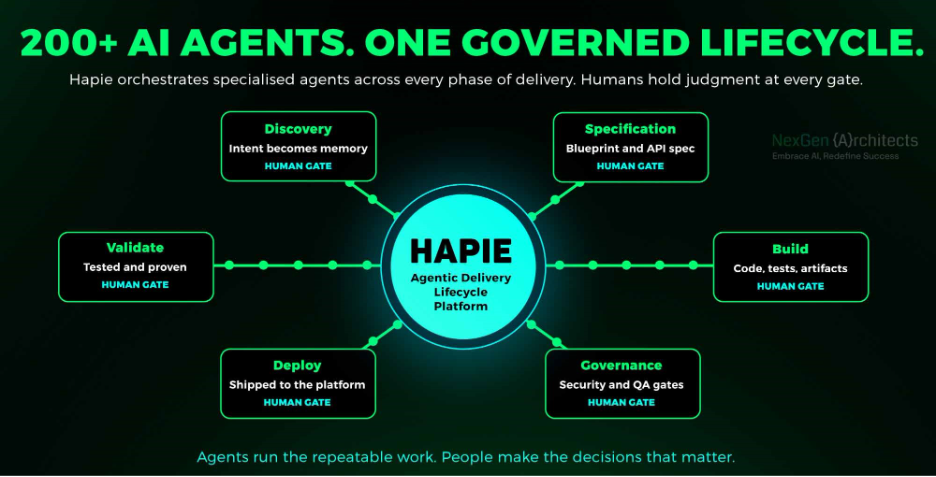
This is why we call it an Agentic Delivery Lifecycle rather than code automation. Writing code was never the expensive part of an enterprise program. The expensive part is understanding the requirement, designing the right architecture, governing the quality and shipping with confidence. Hapie compresses that entire chain, and it does it the same way every time.
Strip away the language and here is the value on the table, for the customer and for the Salesforce account team bringing us in.

The traditional systems integrator is not slow because its people are weak. It is slow because its business model requires billable hours. It cannot compress a delivery cycle without cannibalising its own revenue. We have no such conflict. Our model gets stronger the faster we deliver.
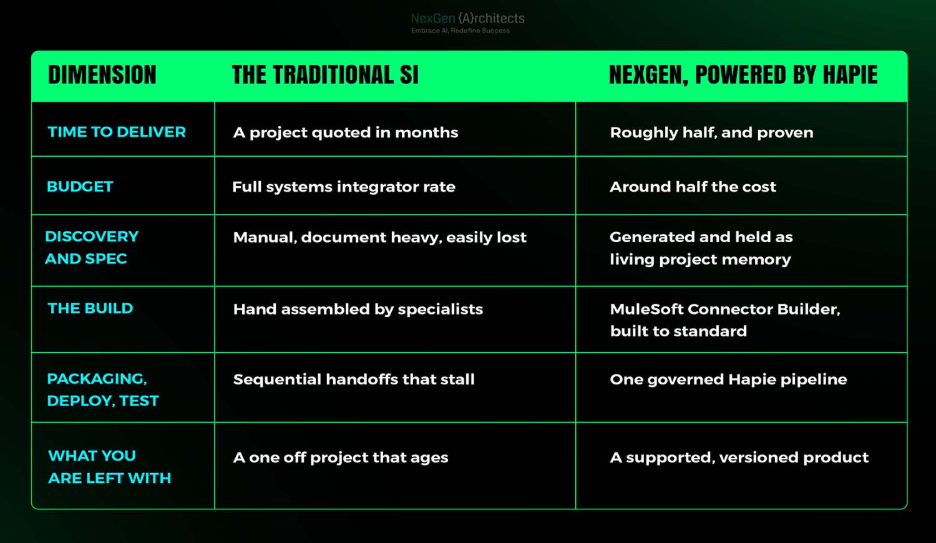
The ServiceNow Connector is one product. The capability behind it is the story. The same pipeline that produced it is now pointed at the next connector, the next Agentforce build, and the next enterprise program that a larger firm has quoted in quarters.
We started inside the Salesforce and MuleSoft ecosystem deliberately. It is where the delivery pain is sharpest, the value is clearest, and the proof is easiest to see. From here it extends outward, and customer demand decides what comes next.
Enterprise delivery has run the same way for thirty years. Armies of people, long timelines, and a quote measured in quarters. That era is closing. What replaces it is a small, specialised team with an agentic platform behind it, delivering better outcomes in a fraction of the time. NexGen and Hapie are building exactly that, and the connector on AppExchange is simply the first thing you can go and touch.
.svg)

