No items found.
Salesforce
Jan 30, 2024

Learn how MuleSoft APIs enable Agentforce to access data, execute actions, and automate workflows across ERP, HR, ITSM, and legacy enterprise systems.
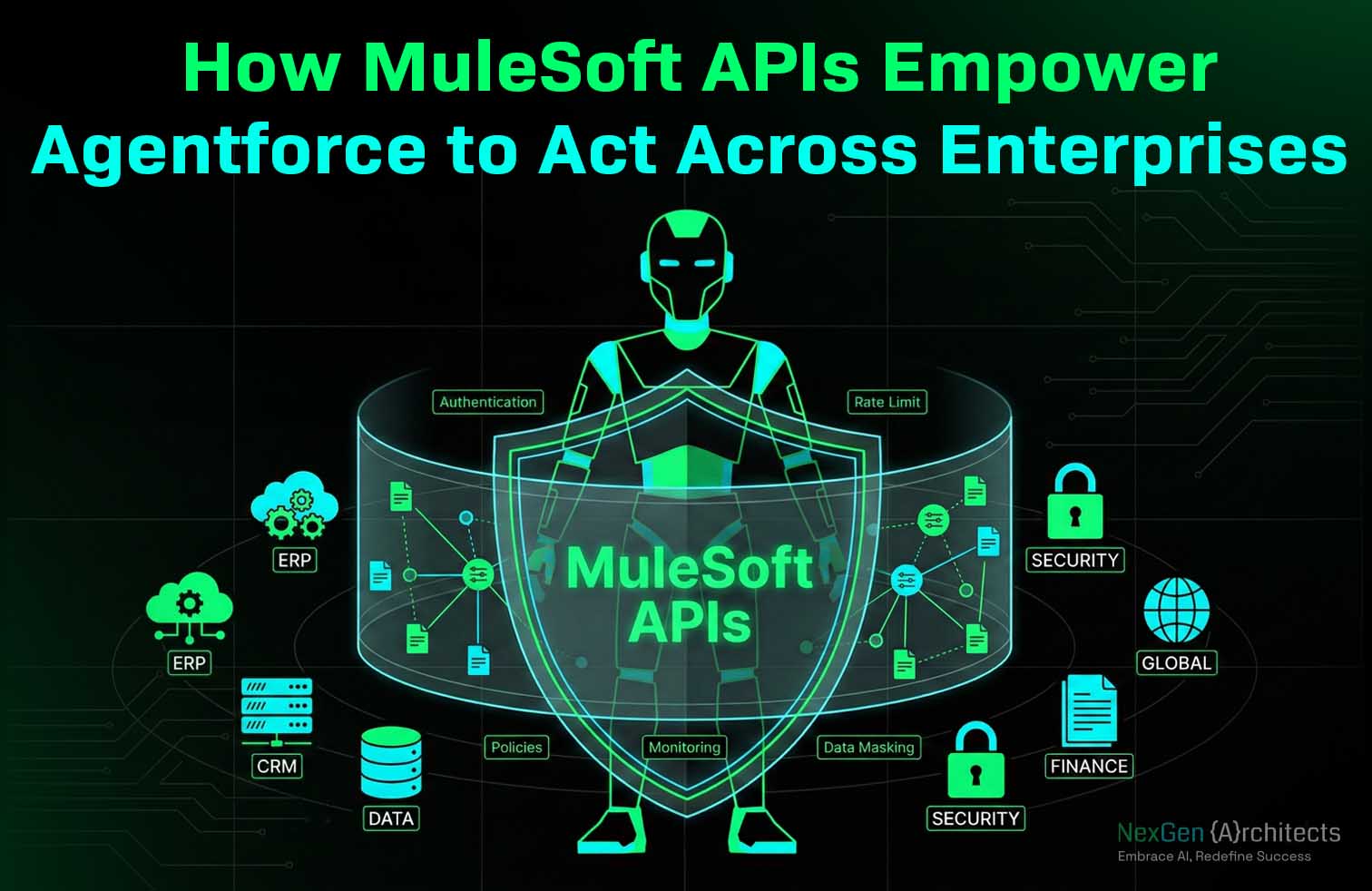
AI agents are no longer experimental. Platforms like Salesforce Agentforce signal a shift from conversational AI to operational AI, systems that do not just respond, but act. However, the real constraint on agentic AI is not reasoning capability. It is reach.
An agent can only be as effective as the systems it can access and the actions it is allowed to perform. In most enterprises, that is where ambition meets reality.
Modern enterprises are not built around a single system of record. Business operations are deliberately spread across specialised platforms, each optimised for a specific domain.
This fragmentation is not a flaw. It is the result of decades of optimisation. But it creates a fundamental challenge for AI agents: no single platform contains the full context or execution path required to resolve real business problems end to end.
Agentforce brings intelligence and autonomy into Salesforce. MuleSoft provides the connective tissue that allows that intelligence to operate beyond Salesforce.
Together, they turn agents from helpful assistants into enterprise-capable digital workers.
On its own, Agentforce excels at reasoning, orchestration, and decision-making within the Salesforce ecosystem. It can interpret intent, apply business logic, and determine the next best action.
What it cannot do by default is reach into every system where data lives or where actions must be executed.
This is where MuleSoft becomes foundational. MuleSoft does not add intelligence to Agentforce. It adds capability.
By exposing enterprise systems through governed APIs, MuleSoft gives Agentforce the ability to retrieve information, trigger workflows, and complete transactions across the organisation. Intelligence without integration remains advisory. Intelligence with integration becomes operational.
For an AI agent to act responsibly, it must understand context, not just conversational context, but business context.
MuleSoft enables Agentforce to access data from systems such as SAP, Workday, Jira, legacy databases, on-premise applications, and third-party SaaS platforms. This access is not achieved through brittle point-to-point connections, but through reusable, managed APIs.
The result is a unified view of the enterprise, assembled dynamically at runtime.
An agent handling a customer escalation can pull order history from an e-commerce platform, inventory availability from ERP, shipment status from logistics systems, and case history from Service Cloud without hardcoding system dependencies.
This is not data aggregation for reporting. It is context assembly for action.
The most significant shift MuleSoft enables is the transition from AI that informs to AI that executes.
Without integration, agents can explain what should happen. With MuleSoft APIs, they can make it happen.
An Agentforce agent can:
This changes the role of AI inside the enterprise. Instead of waiting for humans to translate insight into action, agents can close the loop themselves within defined guardrails.
That is the difference between automation suggestions and digital labour.
Real enterprise problems rarely live in a single system. They unfold across domains.
MuleSoft allows Agentforce to participate in complex, multi-step workflows where each step may involve a different platform. These workflows are not embedded in the agent itself. They are externalised, governed, and observable.
For example, when an agent handles a delayed order, it can:
Each step is executed via MuleSoft-managed APIs, ensuring consistency, security, and auditability.
The agent focuses on intent and decision-making. MuleSoft handles execution and orchestration.
One of the biggest risks with autonomous agents is uncontrolled access.
MuleSoft mitigates this by acting as a central governance layer. APIs exposed to Agentforce are versioned, secured, monitored, and policy-controlled. Authentication, rate limiting, data masking, and compliance controls are enforced consistently.
This allows organisations to scale agent capabilities without sacrificing control.
Agents do not connect directly to systems. They interact through APIs that embody business rules and security policies. This separation is critical for enterprise trust.
MuleSoft’s API-led connectivity model encourages reuse. Once APIs are built and governed, they can support multiple agents, use cases, and teams.
This dramatically reduces the effort required to expand Agentforce capabilities over time. New agents do not require new integrations. They consume existing APIs.
As business needs evolve, agents can be reconfigured rather than rebuilt. This modularity is what allows organisations to scale agentic AI without accumulating technical debt.
Not every situation should be handled autonomously. MuleSoft also enables smooth handoffs between agents and humans.
When an agent escalates a case, all context gathered across systems travels with it. Human agents do not need to re-ask questions or reassemble information manually.
This continuity improves efficiency, reduces frustration, and preserves trust—both internally and with customers.
Agentforce introduces intelligence. MuleSoft enables execution. Together, they address the real constraint facing enterprise AI: the gap between knowing and doing.
This is not about chatbots or productivity features. It is about redesigning how work flows through the organisation when intelligence is allowed to act, safely and at scale.
Agentforce without integration is insightful. Agentforce with MuleSoft is operational.
By breaking down system silos, enforcing governance, and enabling secure execution across the enterprise, MuleSoft APIs turn Agentforce into a true agentic platform capable of resolving complex, multi-system tasks autonomously.
If your organisation is exploring Agentforce, the real question is not whether your agents are intelligent enough. It is whether your integration architecture is ready to let them work.
At NexGen Architects, we help enterprises design MuleSoft and Agentforce architectures that move AI from experimentation into execution. If you’re ready to build agents that can act across your business, we should talk.
.svg)

