No items found.
AI
Jan 30, 2024

How Agentforce uses unified data, Atlas reasoning, and MuleSoft APIs to execute HR, IT, and enterprise workflows with governance and auditability.
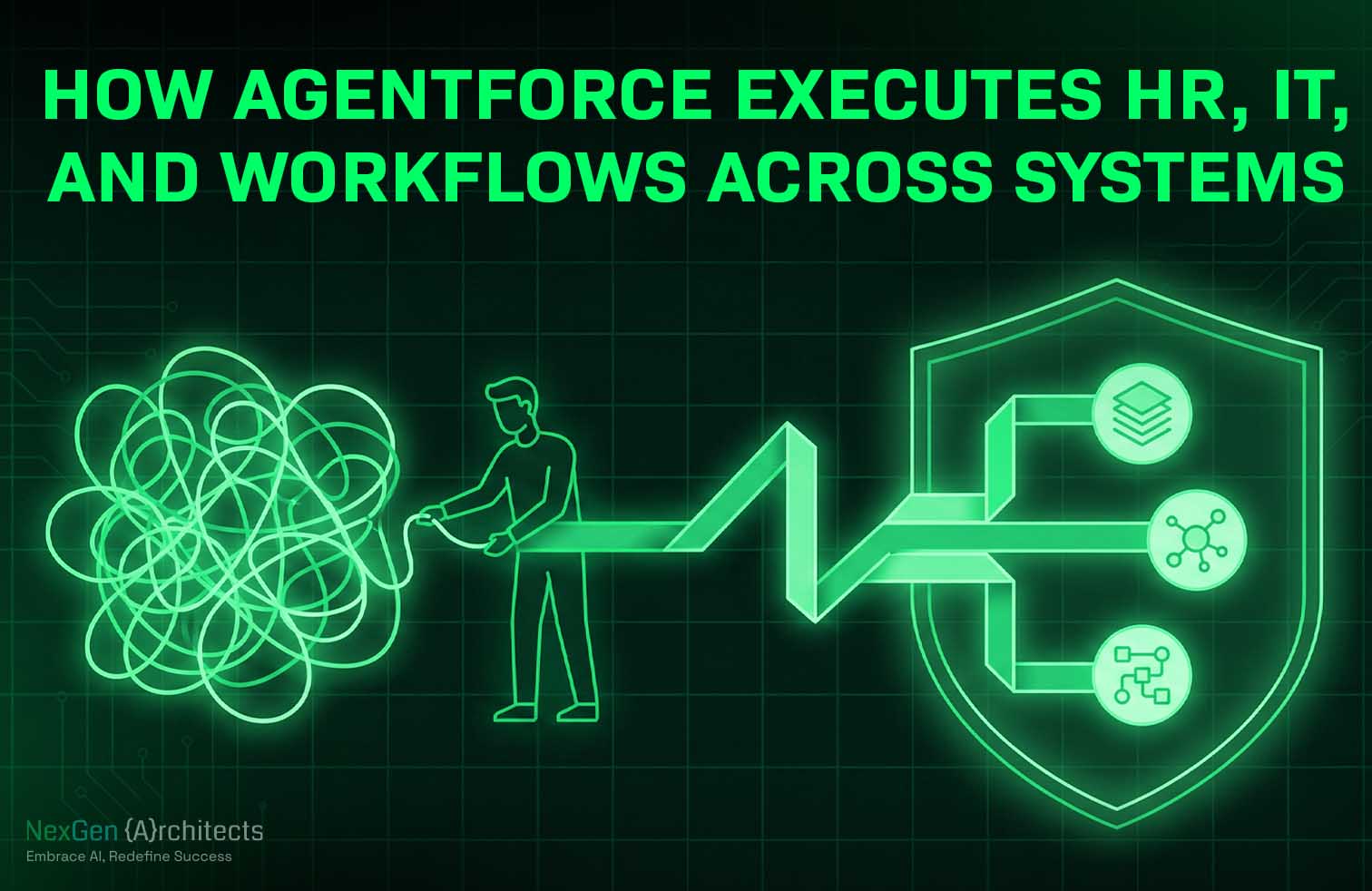
Enterprises have spent years automating individual processes, yet execution across systems has remained fragmented. HR workflows live in HRIS platforms, IT processes sit inside ITSM tools, and business operations span CRM, ERP, and custom applications. Even when automation exists, it is usually confined to a single system boundary.
Salesforce Agentforce changes this execution model. Instead of automating isolated steps, it enables autonomous agents to reason over intent, access unified data, and execute actions across systems without human coordination. This shift matters because enterprise work increasingly requires cross-system execution, not isolated task completion. Agentforce does not replace workflows. It orchestrates them.
Most enterprise automation platforms were designed around deterministic flows. A trigger fires, a predefined sequence runs, and the process completes. This model works when inputs are predictable and systems are tightly scoped.
The problem appears when work spans domains. An employee request often touches multiple systems: HR data, identity systems, finance rules, policy documents, and collaboration tools. Traditional automation struggles because it cannot reason about intent, choose actions dynamically, or adapt to incomplete context.
As a result, enterprises fall back to ticket queues, manual triage, and human coordination. Speed suffers, and scale becomes expensive.
Agentforce addresses this gap by combining reasoning, data unification, and execution into a single operational loop.
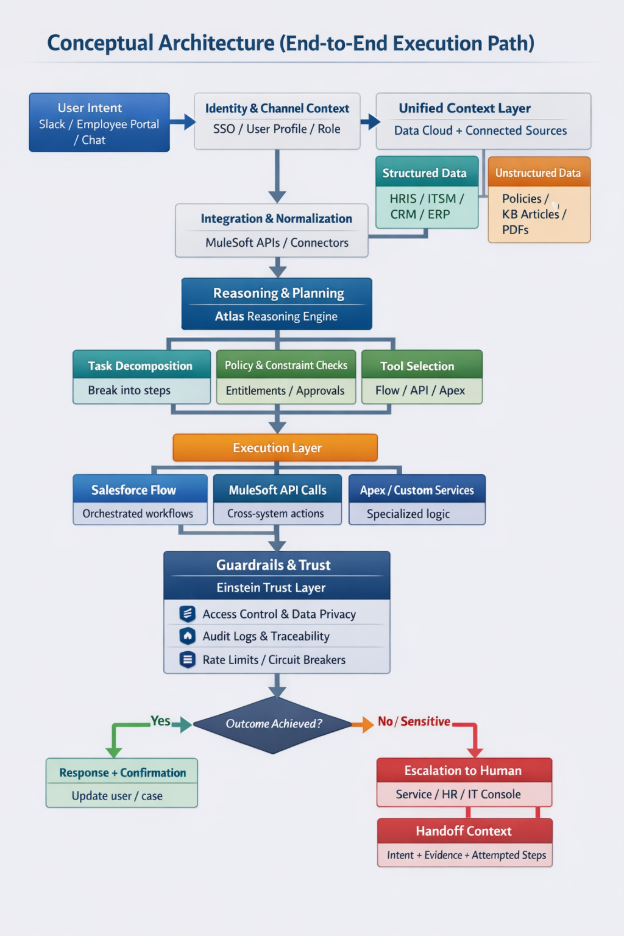
Agentforce operates through a consistent execution pattern regardless of domain. Whether handling an HR request, an IT incident, or a business workflow, the underlying mechanics remain the same.
Execution begins with context. Agentforce unifies structured and unstructured data across systems using Salesforce Data Cloud and MuleSoft integrations. HR records, IT configuration data, policy documents, and knowledge articles are brought together into a coherent, queryable context.
This step is critical. Without unified context, agents cannot reason safely or act deterministically. Data unification is not an enrichment step; it is a prerequisite for autonomous execution.
MuleSoft plays a central role here by connecting external and legacy systems, ensuring that agents can retrieve and update information where it already lives.
Once context is established, the Atlas Reasoning Engine interprets the user’s request. Rather than matching keywords or triggering static flows, Atlas breaks intent into discrete steps and determines which actions are required to reach an outcome.
Atlas Reasoning Engine evaluates constraints, policies, and system availability before constructing an execution plan. This allows Agentforce to handle multi-step workflows that cannot be pre-modeled exhaustively.
The outcome is not a single response, but a sequence of decisions and actions tailored to the situation.
Execution happens through existing enterprise mechanisms. Agentforce invokes Salesforce Flows, APIs, Apex logic, or external services depending on where the action must occur.
This is a key architectural point: Agentforce does not bypass enterprise systems. It activates them. Work is executed in the systems of record, preserving data integrity, compliance, and auditability.
Autonomous execution without controls is not viable in enterprise environments. Agentforce operates within defined guardrails enforced by the Einstein Trust Layer. Every action is logged, permissions are respected, and sensitive scenarios trigger escalation rather than automation.
This governance model ensures that autonomy increases throughput without increasing risk.
HR operations are a natural fit for agentic execution because they combine high volume, policy-driven logic, and cross-system dependencies.
Agentforce shifts HR from a ticket-centric model to an intent-driven one.
Employees interact with Agentforce through natural language in tools like Slack or employee portals. Requests such as checking leave balances, updating personal details, or submitting expenses are interpreted and executed directly against HR systems.
The agent does not merely answer questions. It performs actions, validates policy compliance, and updates records in real time.
Not all HR requests should be automated. Agentforce distinguishes between routine and sensitive cases by reasoning over intent and context. When escalation is required, the case is routed to a human HR representative with full background information already assembled.
This reduces handling time while preserving human judgment where it matters.
By integrating HRIS, HCM systems, and Data Cloud, Agentforce provides HR teams with a consolidated view of employee data. This eliminates system switching and allows HR professionals to focus on complex, people-centric work rather than administrative coordination.
IT service management traditionally relies on tickets, queues, and manual diagnostics. Agentforce changes this by embedding reasoning and execution directly into the support interaction.
Employees can request IT support conversationally. Agentforce interprets the issue, retrieves relevant knowledge, and guides the employee through resolution steps. When possible, it executes corrective actions automatically, such as access resets or configuration updates.
This reduces resolution time from hours to seconds.
Agentforce can detect incidents based on signals from monitoring systems and historical patterns. When a major issue occurs, it can notify affected users, create incident records, and suggest remediation steps before tickets accumulate.
Execution becomes proactive rather than reactive.
An embedded configuration management view allows Agentforce to understand dependencies across infrastructure components. This context enables faster root-cause analysis and more precise remediation actions during incidents.
Beyond HR and IT, Agentforce applies the same execution model to broader business processes.
Agents can qualify leads, generate personalized communications, manage order tracking, and handle service requests by orchestrating actions across CRM, commerce, and fulfillment systems.
Execution happens where the work already resides, preserving existing investments.
Agentforce executes workflows such as invoice validation, expense approvals, and compliance checks by integrating ERP systems and policy frameworks. The agent reasons over rules and data before taking action, reducing manual intervention.
Cross-system execution depends on reliable APIs. MuleSoft enables Agentforce to coordinate actions across heterogeneous systems without hard-coding logic. This orchestration layer is what allows agents to operate across domains rather than within silos.
Agentforce represents a shift from workflow automation to outcome-driven execution. Instead of modeling every path in advance, enterprises allow agents to reason, decide, and act within defined boundaries.
This model scales because it absorbs complexity rather than encoding it into static flows. It also aligns with how work actually happens across modern enterprises.
Agentforce is not an HR tool or an IT tool. It is an execution layer that sits above systems, unifying data, reasoning over intent, and activating workflows across the enterprise.
Organizations that adopt this model move from managing processes to enabling outcomes.
Agentforce executes HR, IT, and enterprise workflows by combining unified data, reasoning-driven planning, and governed action across systems. It does not replace existing platforms. It coordinates them.
As enterprises introduce AI agents into operational environments, execution consistency, governance, and cross-system orchestration become non-negotiable. Agentforce provides a blueprint for how autonomous execution can work at enterprise scale without sacrificing control.
If you’re planning to move from agent demos to real, cross-system execution, a focused Agentforce implementation matters. We help enterprises design the right execution architecture, integrate Agentforce with MuleSoft and core systems, and put the right guardrails in place, so agents operate safely at scale.
.svg)

