No items found.
AI
Jan 30, 2024

Learn how Microsoft Fabric and MuleSoft Agent Fabric create a connected foundation for trusted data, governed AI actions, and scalable agentic workflows.
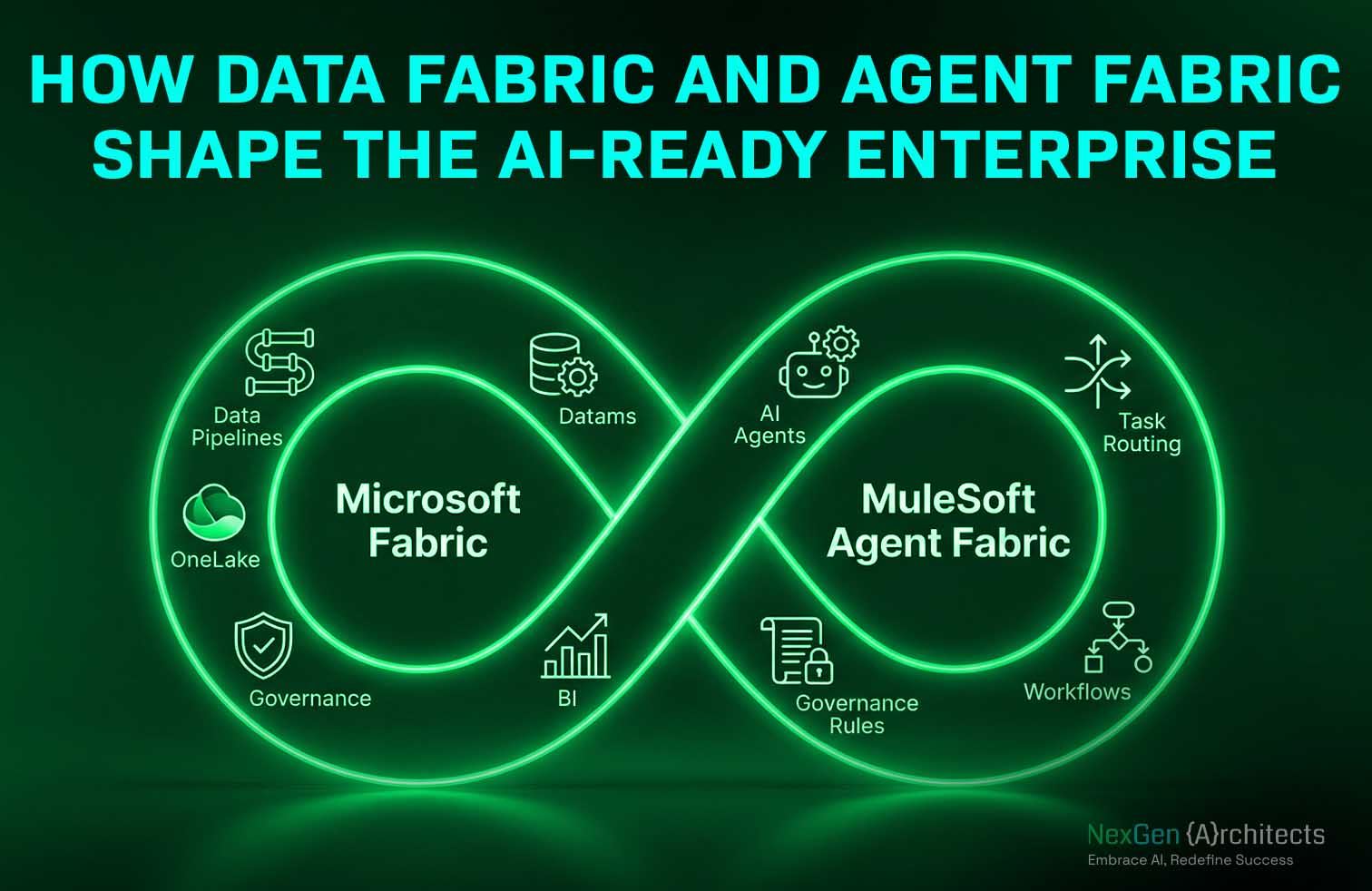
Enterprises have spent years modernizing data platforms, standardizing information flows, and building analytics capabilities. Solutions like Microsoft Fabric have played a central role in that journey bringing together data engineering, warehousing, lakehouses, governance, and BI into a single environment. For many organizations, this was the foundation they needed to trust their data and accelerate digital transformation.
But as AI moves from experimentation to real operational use, a new challenge has emerged.
Data alone doesn’t produce outcomes. Intelligent actions do. This shift is where MuleSoft Agent Fabric enters the picture. While Microsoft Fabric organizes and governs data, Agent Fabric orchestrates and governs the AI agents that act on that data. Together, they represent the two halves of a modern AI-enabled enterprise: trusted inputs and trusted outputs.
This blog explores how they complement each other, and why this combination signals a major turning point in enterprise architecture.
Before unified platforms emerged, enterprise data was distributed across warehouses, lakes, databases, SaaS applications, and legacy systems. Each carried different formats, pipelines, and governance requirements.
Microsoft Fabric addressed this long-standing fragmentation by providing:
For enterprises, this meant something powerful: trusted, standardized, and well-governed data at scale.
Microsoft Fabric solved the “data readiness” problem ensuring that whatever AI or analytics initiatives came next would be built on a clean, consistent foundation.
But as AI adoption grows, a new question follows: How do you govern the actions taken by AI, not just the data feeding it?
As AI agents begin interacting with business systems, updating records, resolving cases, triggering workflows, the need for operational governance becomes critical. So, then comes MuleSoft Agent Fabric as a solution, a platform designed to orchestrate, monitor, and secure the work of AI agents across an enterprise.
While Microsoft Fabric governs information, Agent Fabric governs behavior.
The distinction is simple but important:
Agent Fabric introduces a structured way for enterprises to deploy AI safely and predictably, through capabilities such as:
A directory where every AI agent, internal or vendor-provided, is registered, versioned, and made auditable. Enterprises gain clarity over which agents exist, who owns them, and what they are allowed to do.
A routing and orchestration mechanism that assigns work across agents based on policy, capability, or context. This ensures tasks are completed efficiently and consistently across departments and systems.
A real-time map showing how agents interact with systems, data, and each other.
It makes previously hidden connections visible, helping teams understand impact, dependencies, and flow patterns.
Policies for security, compliance, access control, and system boundaries.
This prevents unauthorized actions, enforces responsible behavior, and provides the auditability regulators increasingly require.
Together, these components shift enterprise AI from ungoverned experimentation to structured, reliable operations.
The transformative insight is that these platforms are complementary.
Data is cleaned, governed, modeled, and made consistently ensuring AI decisions are built on reliable foundations.
AI agents act on systems with clear rules, oversight, and operational safeguards.
The combination results in:
This closes the loop from data readiness → intelligent action → measurable outcomes.
Enterprises no longer need to rely on fragmented workflows: one system for data, another for analytics, and disconnected tools for AI orchestration. With both fabrics in place, the architecture becomes unified end-to-end.
The shift from “data-first” thinking to “intelligence-first” thinking is redefining modern IT strategy. As enterprises adopt agentic AI models, the need for structured governance becomes non-negotiable.
We are moving toward architectures built around:
This marks a natural evolution in enterprise maturity:
From data fabrics → to agent fabrics
From governed knowledge → to governed intelligence
From analytics → to autonomous workflows
It’s not about choosing between Microsoft Fabric and MuleSoft Agent Fabric. It’s about combining them to build a full, reliable AI ecosystem.
Enterprises have made tremendous progress in solving the data challenge, largely thanks to platforms like Microsoft Fabric. But as AI moves from insights to real operations, organizations also need a way to manage and govern the actions AI takes across their systems.
This is the role MuleSoft Agent Fabric fills bringing structure, oversight, and accountability to the world of agentic AI.
Together, both fabrics offer a complete blueprint for the AI-enabled enterprise: trusted data feeding trusted intelligence. The future of enterprise architecture is not just about managing information. It’s about managing intelligent behavior at scale.
.svg)

