No items found.
AI
Jan 30, 2024

Learn how Agentforce for financial services delivers personalised, compliant, and faster BFSI operations without replacing your people.

Key Takeaways
AI can process millions of transactions, flag suspicious patterns, and generate risk scores in seconds. It cannot sit across from a customer who just lost their home to a fire and explain what their policy covers. It cannot read the hesitation in a retiree's voice when they ask whether their savings will last. It cannot interpret the grey areas in a regulation that was written before the technology existed.
That is why the financial services organisations seeing real results from AI are building systems where machines and people work together, each doing what they do best.
According to industry research, AI technologies can deliver up to $1 trillion in annual value for the banking industry alone. Capturing that value requires more than automation. It requires an architecture where AI handles the volume and humans handle the judgment, with a clean handoff between the two.
Agentforce for financial services is built for exactly this. It automates the repetitive, data-heavy work that consumes your teams while routing the sensitive, complex, and regulated decisions to the people qualified to make them.
The core operations of banking, lending, and insurance are deeply personal. Customers approach financial institutions during major life events: buying a home, planning for retirement, filing an insurance claim after an accident, applying for a business loan. These moments require more than data processing. They require understanding.
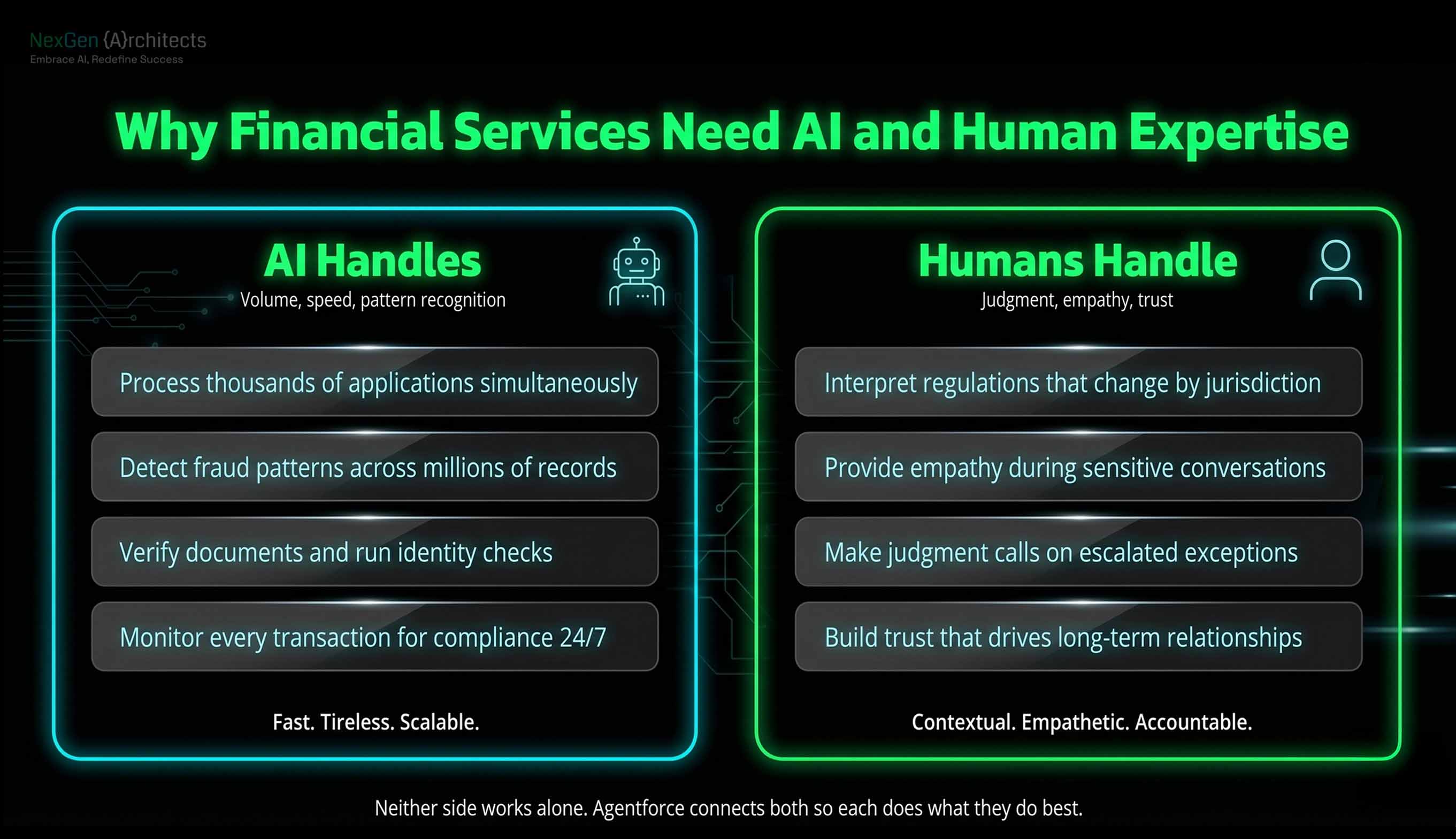
Neither side works well alone. AI without human oversight produces fast decisions that miss context. Human teams without AI support spend 80% of their time on tasks a machine could handle, leaving almost no capacity for the work that actually requires their expertise.
Modern BFSI organisations store customer data across dozens of systems: CRM, core banking, transaction monitoring, support tickets, mobile app interactions, and social channels. When a customer calls, the agent toggles between screens piecing together a profile that should already exist in one place.
Agentforce for financial services aggregates data from every source into a single customer 360 profile through Salesforce Financial Services Cloud and Data Cloud.
What this changes in practice:
The customer feels understood. The advisor feels prepared. The institution captures more revenue per interaction because the conversation starts from context instead of from zero.
Onboarding is the first experience a customer has with a financial institution. In most banks, it is also the worst. Paper forms, manual identity verification, multiple handoffs between departments, and days of waiting before the account is active.
What Agentforce Automates
Where Humans Step In
The result: onboarding that takes hours instead of days, with higher completion rates and fewer drop-offs. The customer gets speed. The compliance team gets accuracy. The institution gets a faster path to revenue.
Customers expect their bank or wealth manager to anticipate their needs, not just react to requests. Most financial institutions have the data to do this. They lack the architecture to turn that data into timely, relevant advice at scale.
Agentforce analyses spending patterns, savings behaviour, investment performance, and life stage indicators across the customer base. It identifies opportunities and generates recommendations that human advisors then review, refine, and deliver.
What this looks like in practice:
The AI spots the pattern. The human delivers the advice. The customer receives personalised financial guidance that feels proactive instead of generic.
Compliance automation in banking is where AI delivers some of its clearest value. Regulatory monitoring is continuous, data-intensive, and unforgiving of gaps. Human teams alone cannot monitor every transaction, every communication, and every data access event across an entire institution.
What Agentforce Monitors Automatically
What Gets Escalated to Humans
The AI provides 24/7 surveillance across every transaction. Human compliance officers focus their time on the cases that require investigation and judgment. The institution maintains continuous monitoring without hiring an army of analysts.
Insurance claims are moments that define customer trust. A policyholder whose car was totalled or whose house flooded is stressed, anxious, and looking for reassurance. The speed and empathy of the claims experience determines whether they renew or leave.
What AI Handles in Claims
What Humans Handle
The AI processes the volume. The human handles the judgment and the empathy. Legitimate claims settle faster. Fraudulent claims get caught earlier. Policyholders feel heard during the moments that matter most.
In financial services, support requests range from "what is my balance" to "I think someone stole my identity." Treating both with the same process wastes human capacity on simple queries and leaves complex cases waiting in the same queue.
Agentforce creates a tiered support model:
Tier 1 (AI handles entirely)
Balance inquiries, transaction history, payment due dates, branch hours, document requests, password resets. These queries resolve in seconds without a human touching them.
Tier 2 (AI assists while human supervises)
Dispute initiation, card replacement, address changes on regulated accounts. The AI completes the action and a human reviews before confirmation.
Tier 3 (human handles with AI context)
Fraud reports, complex complaints, regulatory inquiries, relationship-level escalations. The human agent receives the full conversation history, customer profile, and AI-generated summary so the customer never repeats themselves.
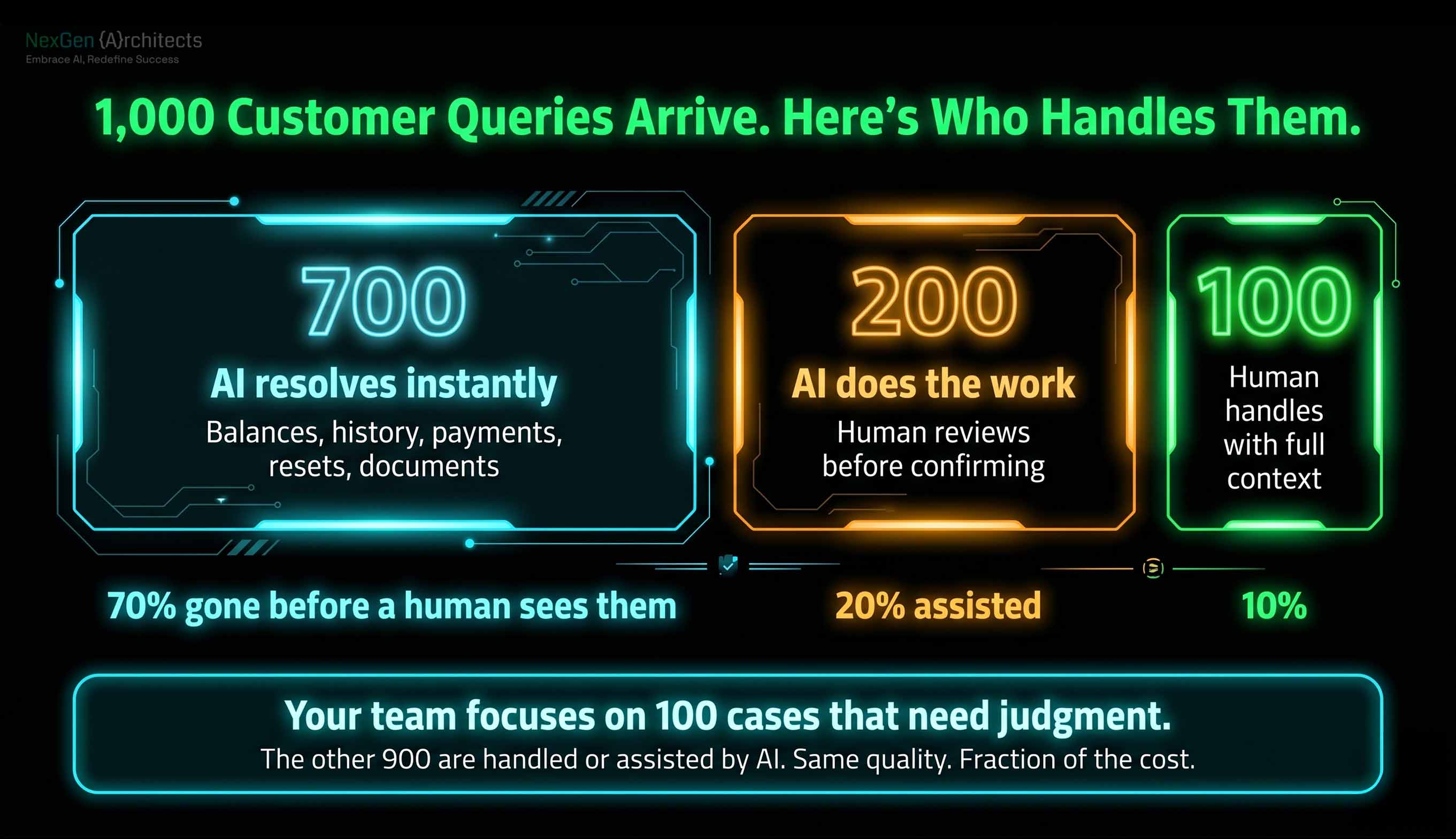
The escalation logic routes each case to the right tier based on complexity, urgency, and regulatory requirements. Simple queries stop consuming human time. Complex cases get faster resolution because the agent starts with full context.
Cross-selling in financial services has a trust problem. Customers resent product pushes that feel irrelevant. Regulators scrutinise aggressive sales practices. The institutions that cross-sell effectively are the ones that make relevant recommendations at the right moment, through the right channel.
Agentforce analyses customer 360 profiles to identify genuine product fit:
The AI identifies the opportunity. The human advisor evaluates whether the timing is right and the product genuinely fits the customer's situation. The recommendation feels helpful instead of salesy because it is based on real behaviour, delivered by a person who understands the customer's context.
When Agentforce for financial services is implemented properly, every department operates with the same customer data, the same AI insights, and the same escalation logic.
Front office: Relationship managers see AI-generated next-best-action suggestions alongside the full customer profile. They choose which recommendations to act on and how to deliver them.
Operations: Claims processors, onboarding teams, and service agents handle higher volumes with less manual effort because the AI completes the data-heavy steps before the human sees the case.
Compliance: Monitoring runs continuously across every transaction. Officers focus on investigation and judgment instead of data gathering.
IT: The integration layer (MuleSoft) connects core banking, CRM, Data Cloud, and Agentforce into a governed architecture. New data sources plug in through APIs instead of custom scripts.
The institution scales its capacity without scaling its headcount at the same rate. Customers receive faster, more personalised service. Regulators see continuous compliance instead of periodic evidence gathering.
The financial institutions getting value from AI in banking started with one specific, high-volume workflow and expanded from there. They automated KYC onboarding, or claims triage, or compliance monitoring first, proved the model works, then extended it across the organisation.
The ones still debating whether to "adopt AI" as a strategy are watching their competitors onboard customers in hours, settle claims in minutes, and respond to audit requests in days instead of weeks.
The starting point is always the same: pick the workflow where your people spend the most time on tasks a machine should handle, build the AI layer, design the human handoff, measure the result, and expand from there.
For BFSI organisations evaluating how Agentforce fits into their Salesforce and MuleSoft architecture, our team designs these exact implementations.
.svg)

