No items found.
AI
Jan 30, 2024

Salesforce is reinventing Slack as the AI-powered workspace for enterprises. Explore how Slack, Agentforce, and Tableau Next shape the future of work and collaboration.
For years, Slack was celebrated as the platform that redefined workplace communication. But its trajectory changed dramatically once Microsoft bundled Teams into Office 365, reshaping the market almost instantly. What followed is now industry history: rapid Teams adoption, antitrust scrutiny, and a challenging phase for Slack as it tried to hold its ground.
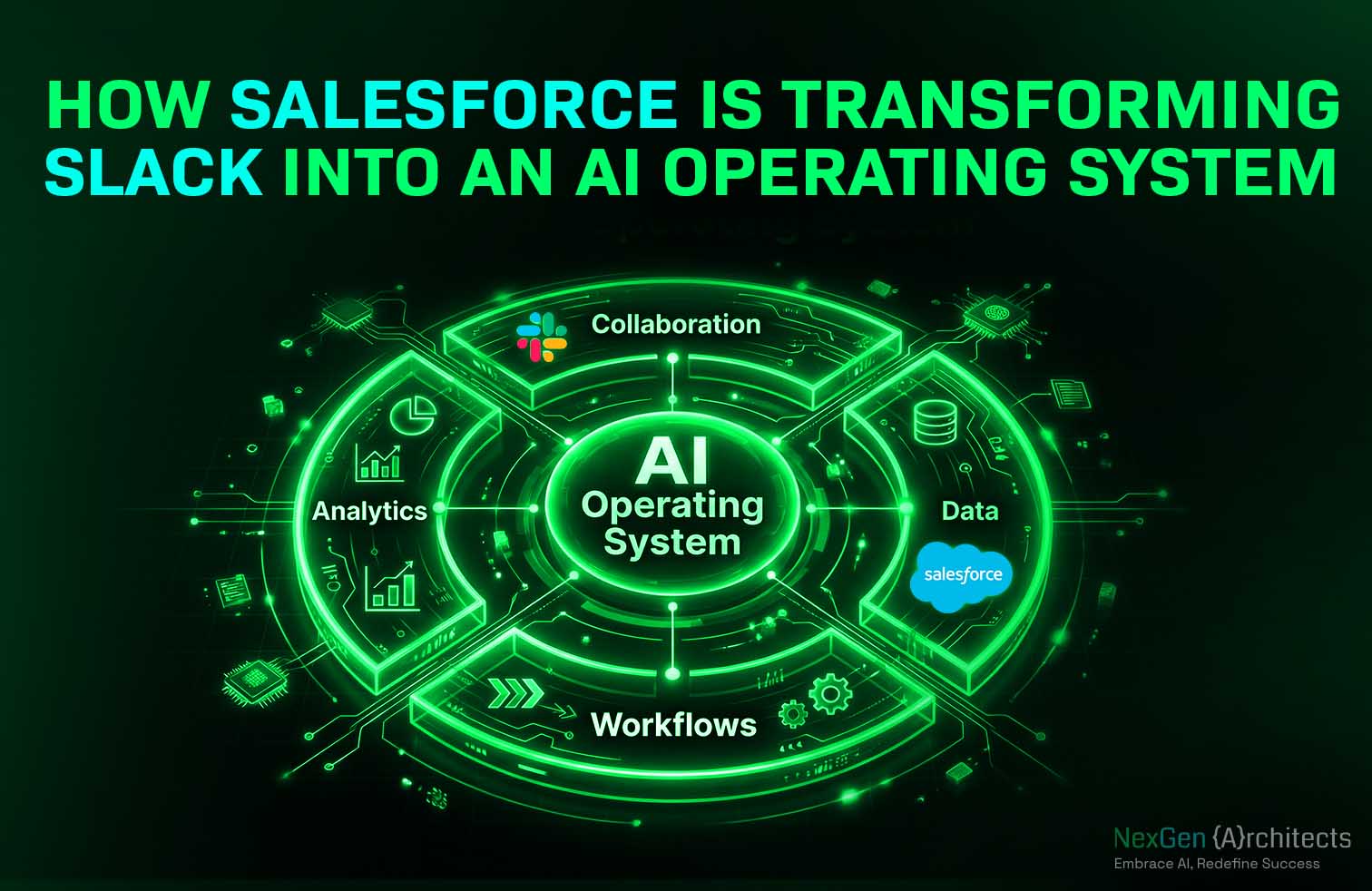
But the real story begins when Salesforce acquired Slack. It’s not to rescue a fading product, but to reimagine how enterprise work should operate in the age of AI. Today, Slack is evolving into the interface where conversations, data, workflows, and AI agents operate together. In other words, Salesforce is transforming Slack into an AI Operating System for enterprise work.
Slack originally rose to prominence because it offered faster, more flexible collaboration than email. But the competitive landscape shifted the moment Microsoft integrated Teams into Office 365.
Teams wasn’t an add-on. It was bundled directly into the subscription enterprises were already paying for no new contracts, no licensing friction, no extra approvals. For CIOs who valued simplicity and cost efficiency, Teams became the default choice.
This led to:
By the time regulators intervened, Microsoft had already secured a dominant position. Slack could no longer win by following the same playbook. It needed a new identity one with deeper enterprise value.
When Salesforce stepped in, they didn’t see Slack as a messaging tool. They saw an opportunity to create a new interface for enterprise work a layer that connects business context with real-time collaboration and AI-driven execution.
Salesforce’s vision for Slack was built on three principles:
Sales teams shouldn’t hunt through dashboards to find deal updates. Customer success shouldn’t sift through multiple systems to understand account risk. Salesforce wanted Slack to be the place where business context appears automatically.
Employees waste hours moving between CRM, email, spreadsheets, dashboards, and chat tools. Slack provides a single workspace where communication and data coexist.
Instead of talking about work in Slack and doing the work in Salesforce, both should happen in the same environment.
This wasn’t an incremental improvement. It was the foundation for Slack’s shift from communication tool to enterprise operating layer.
Once Slack joined the Salesforce ecosystem, it solved one of the biggest friction points in large organizations: business conversations happen in one place, while the actual customer insights live elsewhere.
Salesforce connected Slack across Sales Cloud, Service Cloud, Marketing Cloud, and other products so that:
Instead of checking multiple systems, employees see everything in Slack the moment it happens. The workspace becomes a live reflection of customer operations.
Approvals, escalations, and workflows run directly inside Slack as well. Discount approval? A manager reviews and approves right in Slack. Contract changes? Visible instantly. Escalations? Resolved without leaving the workspace.
Cross-functional collaboration becomes easier because sales, success, support, finance, operations, and product teams all work in the same shared environment tied to a Salesforce record. There’s no confusion about where conversations happened or what the latest customer status is. Slack becomes the anchor for decisions, not just discussions.
This dramatically reduces the invisible cost of context switching. Employees stay in Slack while Salesforce works in the background, bringing the right information into the conversation at the right time.
Agentforce is Salesforce’s AI agent platform, and its integration with Slack unlocks another level of operational intelligence.
Now employees can ask Slack to:
Every AI response is grounded in Salesforce’s unified data, meaning it’s accurate, contextual, and relevant to the exact customer, deal, or case being discussed.
Instead of using AI in a separate tool, Agentforce participates inside the conversation:
Slack becomes the command interface for intelligent, data-backed execution.
Salesforce took the next step by embedding Slack’s collaboration model into Salesforce itself through Salesforce Channels.
A Salesforce Channel is a real-time workspace tied to a specific CRM record an account, case, opportunity, or project. Instead of scattering conversations across tools, everything related to that record is centralized:
If an opportunity progresses, everyone sees it. If a case becomes critical, the right team is alerted immediately. If a risk appears, AI highlights it inside the channel.
There’s no switching between Salesforce tabs, Slack conversations, dashboards, and email threads.
The work, the conversation, the context, and the intelligence all live in one continuous environment.
This is where Slack truly begins functioning like an operating system coordinating human workflows, AI insights, and customer data in one place.
Analytics historically required navigating dashboards, knowing filters, and interpreting visualizations. Tableau Next changes that entirely by bringing analytics into Slack.
Now leaders can ask:
Slack returns:
This makes analytics part of daily decision-making rather than a separate reporting task. AI highlights insights before people even think to look for them. Decisions become faster, clearer, and more evidence-driven.
Enterprises adopting AI often face the same challenges: fragmented systems, disconnected data, siloed teams, and constant application switching. Slack solves these structural issues by becoming the place where all work converges.
Slack now benefits from:
For employees, Slack becomes the space where thinking, collaborating, deciding, and acting happen with AI continuously enriching the flow.
Every layer reinforces the idea that Slack is no longer the messaging tool it once was.
It is the environment where enterprise work actually runs.
As these capabilities come together real-time customer context, embedded AI agents, unified workspaces, and conversational analytics Slack evolves into more than a hub for communication. It becomes the coordination layer for the entire Salesforce ecosystem.
Like a traditional operating system orchestrates applications, resources, and processes, Slack now orchestrates:
AI doesn't sit outside the workflow. It lives inside it. Work doesn’t jump between tools. It unfolds in one place.
This is what transforms Slack into the Operating System for the AI-driven enterprise.
Slack’s transformation under Salesforce represents a new direction for enterprise productivity. It’s no longer just a chat platform it has become the unified environment where customer activity, internal communication, AI insights, and execution all intersect.
Slack brings together Salesforce’s data, Agentforce’s intelligence, Tableau’s analytics, and teams’ operational workflows into one seamless experience. The result is an operating system for enterprise work: a single environment where decisions are made with context, where AI guides action instead of sitting in the background, and where teams operate with clarity and speed.
In a world where work becomes more complex, distributed, and AI-powered, Slack is emerging as the central interface where everything comes together.
.svg)

