No items found.
AI
Jan 30, 2024

Explore real-world Agentforce use cases across sales, service, and operations. Learn how Salesforce AI agents improve productivity, speed execution, and scale workflows.
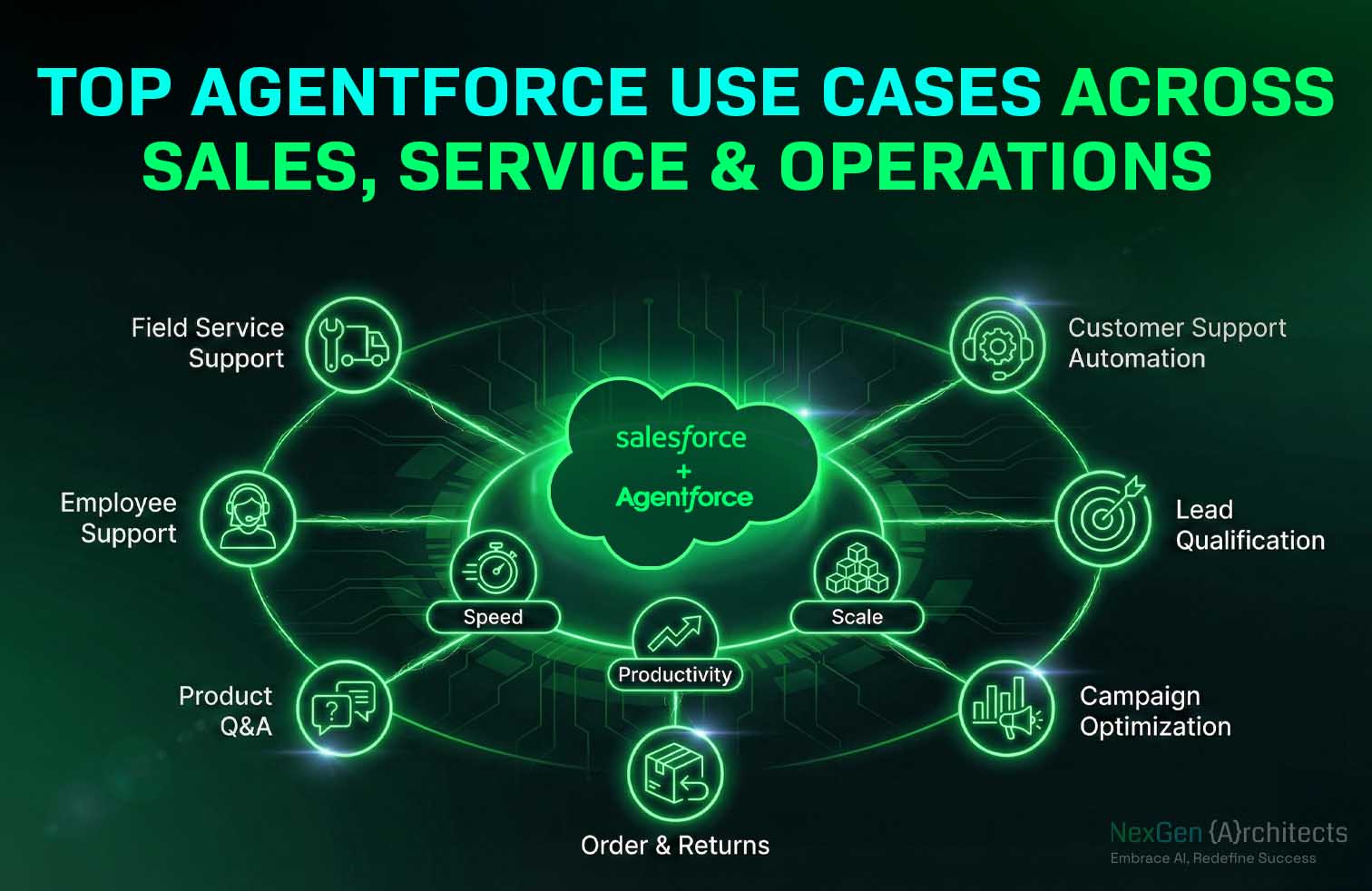
Agentforce use cases look impressive on slides. Where they matter is in the places where teams usually lose time, context, and momentum. This article walks through where Agentforce is actually being used across sales, service, and operations, and why those areas tend to show results faster than others.
Most organisations don’t struggle because they lack intelligence. They struggle because everyday work depends on too many small hand-offs. Someone has to notice that a lead is active. Someone has to follow up. Someone has to update the record. Someone has to check another system and respond.
And here comes the Agentforce in the era of AI. Agentforce exists to reduce that dependency.
Instead of treating AI as an assistant that gives suggestions, Agentforce is designed to operate inside Salesforce as a task-executing layer. It can read what’s happening, understand what’s required next, and act within the rules it’s been given.
As customer demand increases and teams are expected to scale without growing headcount, and this has become increasingly relevant. In this blog, we’ll cover where organisations are applying Agentforce today and why these use cases tend to stick.
Agentforce is most effective when it’s applied to work that already happens every day. These aren’t edge cases or experimental workflows. They are the repetitive, time-sensitive actions that quietly slow teams down.
Customer support is often the first place organisations start, not because it’s simple, but because the volume makes inefficiencies visible very quickly.
A large percentage of inbound queries follow familiar patterns. Customers ask about order status, refunds, appointments, billing details, or access issues. Traditionally, these requests create tickets, queues, and delays, even when the answer already exists in the system.
Agentforce changes that dynamic.
Instead of routing every request to a human agent, the system can respond directly by pulling live information from Salesforce and connected platforms. A customer asking about a refund doesn’t receive a generic answer. The agent checks the transaction, confirms eligibility, and responds with a specific update.
When a request falls outside defined boundaries, it’s escalated with context already captured. That context is what saves time. Agents aren’t starting from scratch, and customers don’t have to repeat themselves.
Key Benefits Teams Experience
Sales teams rarely lose deals because they don’t know what to do. They lose deals because timing slips and follow-ups get delayed.
Agentforce is increasingly used to monitor lead activity and trigger action without waiting for manual review. When engagement signals change repeated visits, content downloads, proposal views the system can react immediately.
Instead of asking a rep to scan dashboards, the agent highlights what matters and suggests what to do next. In some cases, it can take the first step itself, drafting outreach or scheduling a follow-up within approved guidelines.
CRM data also improves as a result. Activities are logged automatically, stages are kept current, and pipeline views reflect reality more closely.
Key Benefits Teams Experience
Marketing teams deal with constant trade-offs. Personalisation takes time. Speed often reduces quality. Manual optimisation slows campaigns down.
Agentforce helps by acting as a decision support layer during execution rather than planning alone.
Campaign performance doesn’t need to wait until the end to be evaluated. Agents can observe engagement patterns as they happen and recommend adjustments while campaigns are live. That might mean changing send times, refining messaging, or shifting focus to segments showing stronger response.
This doesn’t remove marketers from the loop. It removes the delay between insight and action.
Key Benefits Teams Experience
Post-purchase support is where customer patience tends to wear thin. Waiting for updates, chasing deliveries, or navigating returns creates frustration quickly.
Agentforce allows customers to get answers directly. Order status, shipping updates, return eligibility, and refund progress can all be handled without opening a ticket.
When something goes wrong like damaged goods, delayed shipments, or partial deliveries, the agent can initiate the standard process immediately. Customers receive clarity instead of silence.
This reduces inbound volume and improves the experience at the same time.
Key Benefits Teams Experience
A surprising number of support interactions aren’t problems at all. They’re questions. Customers want to compare products, understand specifications, or confirm warranty terms.
Agentforce makes this information accessible without requiring a live agent. Because it draws from structured product data and knowledge bases, answers remain accurate and consistent.
Beyond answering questions, the system can suggest alternatives or complementary products based on behaviour and history. This feels helpful rather than pushy when done correctly.
Key Benefits Teams Experience
Many organisations overlook how much internal time is lost to simple questions. Password resets, policy clarification, access requests, and onboarding steps create steady background noise for IT and HR teams.
Agentforce can handle a large portion of this internally. Employees ask questions in plain language and receive immediate responses based on internal documentation and system data.
When something requires approval or manual intervention, the agent creates the request with the right details attached.
Key Benefits Teams Experience
7. Field Service and Technician Support
Field service teams rely on information being available at the right moment. Missing details slow jobs down and increase repeat visits.
Agentforce supports technicians by making service history, diagnostics, and inventory data accessible on demand. Before arriving on site, technicians can understand what’s been tried before. During the visit, they can check parts availability or follow guided troubleshooting steps.
After the job, updates are captured automatically, reducing paperwork and follow-up delays.
Key Benefits Teams Experience
Industry-Specific Applications of Agentforce
While Agentforce is not built for a single industry, some patterns repeat.
The industry changes, but the core benefit remains the same: fewer delays between request and resolution.
Agentforce works best when it’s applied to work that already exists, rather than imagined use cases.
Across sales, service, and operations, the strongest results come from removing friction that teams have accepted for years. When AI agents are allowed to operate within clear boundaries, work moves faster without becoming chaotic.
Agentforce isn’t about replacing people. It’s about removing the dependency on people for tasks that don’t require judgment every time. That’s where the real value shows up.
Contact us to understand how Agentforce can be applied to your business and where it will deliver the strongest impact.
.svg)

