ai
Discover how Agentforce Voice automates banking calls, including fee reversals and fund transfers, while using AI, compliance checks and human escalation.
Key Takeaways
Agentforce Voice for banking is an AI-powered voice solution that can handle routine customer service requests such as fee reversals and fund transfers through natural-language conversations. It can verify customer identity, apply banking policies, perform eligible actions, record the interaction and escalate complex or high-risk cases to human agents.
Fee reversals and fund transfers are among the highest-volume, most repetitive calls in banking contact centres, consuming agent time that should go toward complex cases.
Agentforce Voice resolves these requests end-to-end through natural conversation, policy-based decision logic, and real-time compliance checks inside Salesforce.
Banks that implemented AI-powered voice solutions in 2025 reported a 38% reduction in average case resolution time.
Every day, thousands of customers call their bank to dispute a fee or move money between accounts. The request is straightforward. The agent handles it in five minutes. The problem is that five minutes, multiplied by thousands of calls, consumes the majority of contact centre capacity.
The agents handling these routine calls are the same agents who should be available for fraud reports, complex complaints, and relationship-level conversations. Instead, they spend their shift processing requests that follow the same steps every single time: verify the customer, check the account, apply the policy, execute the action, log the result.
Agentforce Voice replaces this cycle for routine requests. It understands what the customer is asking in natural language, verifies their identity, checks eligibility against bank policies, executes the action, and logs everything in Salesforce automatically. The customer gets a faster resolution. The agent gets freed up for work that actually requires human judgment.
What Makes Agentforce Voice Different from a Standard IVR or Chatbot?
Traditional IVR systems route calls through fixed menus. Press 1 for balances. Press 2 for transfers. Press 0 to speak to a human. Most customers press 0 immediately because the menu never matches what they actually need.
Standard chatbots follow scripted decision trees. They handle predictable queries but break the moment a customer phrases something unexpectedly. The conversation loops. The customer gets frustrated. The chatbot transfers them to an agent who starts from scratch.
Agentforce Voice operates differently in three ways:
It understands natural language. A customer says "I was charged a fee yesterday and I don't understand why" and the system recognises the intent as a fee dispute without requiring menu navigation.
It reasons through the request. It checks eligibility, applies bank policies, and decides whether to resolve automatically or escalate to a human.
It acts inside Salesforce. It pulls customer data from Data Cloud, executes transactions through connected banking systems, and logs the entire interaction in the CRM without manual entry.
It functions as a digital agent that completes tasks, rather than a voice interface that routes calls.
Suggested Readings: ServiceNow Connector for Salesforce with MuleSoft
When Should Agent force Voice Escalate to a Human?
Agent force Voice should escalate a banking interaction when the request falls outside predefined policies, involves elevated risk, requires human judgment, triggers compliance conditions or requires empathy and relationship-level support.
How Does Agentforce Voice Handle Bank Fee Reversals?
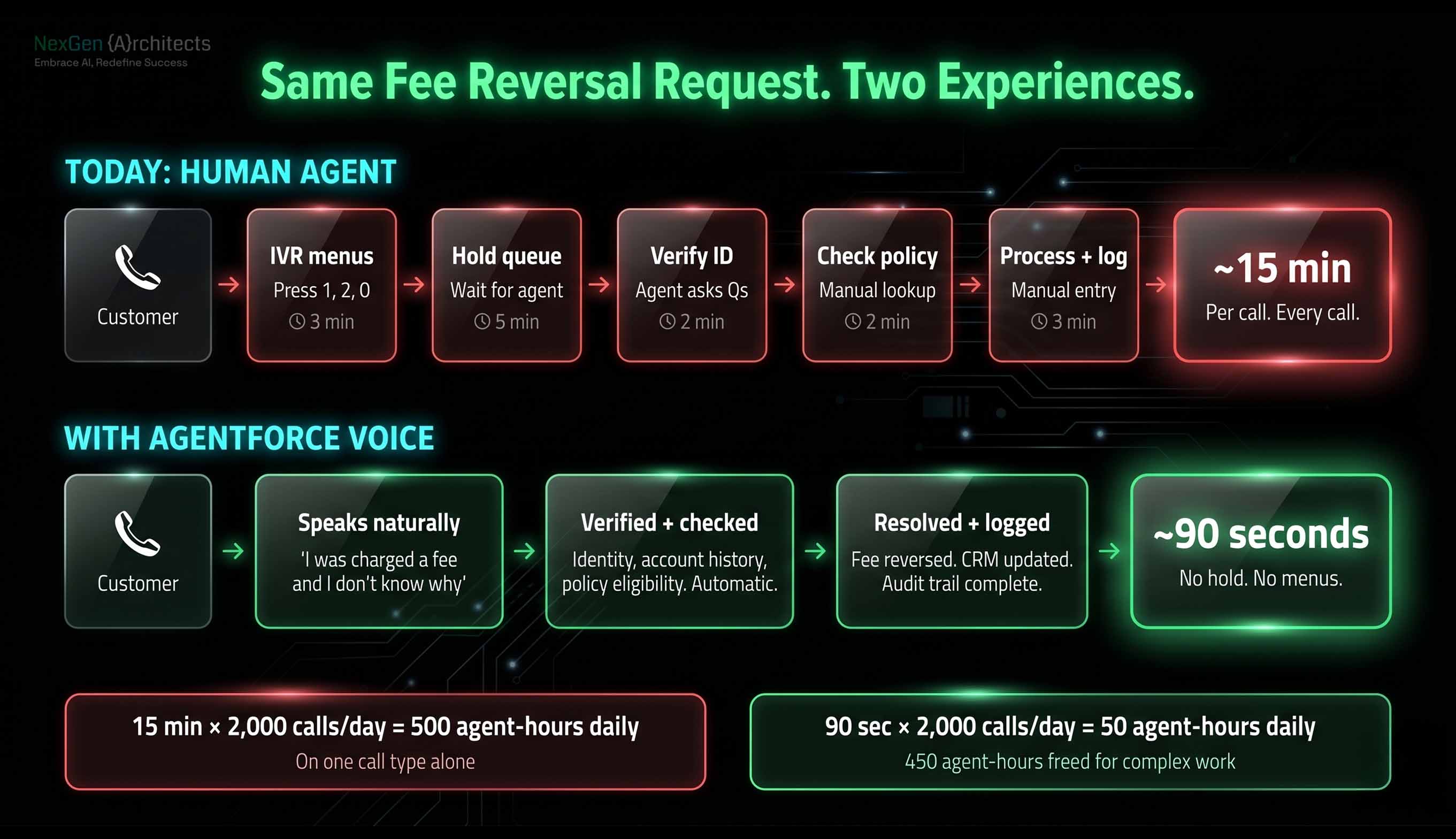
Fee reversals follow the same pattern thousands of times per day. A customer notices an unexpected charge, calls the bank, explains the issue, waits while the agent checks, and either gets the fee reversed or gets told why it stands. Agentforce Voice handles this entire flow in a single conversation.
The customer calls and explains the issue in their own words. The system identifies the intent as a fee reversal request.
Identity verification happens immediately. Through OTP, account details, or voice authentication. Once verified, the system pulls the customer's account history, recent transactions, and previous reversal records from Salesforce Data Cloud.
The system checks eligibility automatically. Has this customer received a reversal in the past 12 months? Is the account in good standing? Does this fee type qualify for automatic reversal? These rules are configured in Salesforce and applied consistently across every call.
If eligible, the reversal processes instantly. The customer receives confirmation during the same call. If the case falls outside automatic approval parameters, it escalates to a human agent who receives:
The full customer profile
Transaction history
Policy checks already performed
A summary of the conversation so far
The customer never repeats themselves. The agent picks up with full context and makes the judgment call.
Everything logs automatically. Conversation transcript, decision outcome, action taken, timestamps, and audit trail. All stored in Salesforce without anyone typing a case note.
How Does Agentforce Voice Automate Bank Fund Transfers?
Fund transfers carry higher security requirements but follow equally predictable steps. Many customers still call for transfers, especially for large amounts, urgent payments, or when they face issues with digital banking access.
The customer calls and states the request. "I need to transfer five thousand pounds from my savings to another account today." Agentforce Voice identifies the intent and begins the secure workflow.
Voice authentication verifies identity. This can include voice biometrics, OTP, or security questions. Only after successful verification does the process continue.
The system confirms details and runs compliance checks in real time:
Source and destination accounts confirmed with the customer
Daily and transaction limits verified
Suspicious activity flags evaluated
Sanctions screening completed
Internal fraud monitoring rules applied
If all checks pass, the transfer executes immediately. The customer receives confirmation of the transaction details on the same call.
If limits are exceeded or compliance flags trigger, the case escalates. The human agent receives verified identity status, transfer details, every compliance check performed, and any risk flags. The full audit trail remains intact for regulatory reporting.
How Does Agentforce Voice Support Banking Security and Compliance?
Agentforce Voice can support banking security and compliance by combining identity checks, authentication, transaction controls, fraud detection, policy-based decision-making, and human oversight within voice interactions. Instead of treating security as a separate step, these controls can be incorporated throughout the customer conversation and transaction workflow.
Identity Verification: Agentforce Voice can verify customer details before providing account information or allowing sensitive requests to proceed, helping ensure that services are provided to the authorized customer.
OTP: For higher-risk requests, the workflow can trigger a one-time password (OTP) verification step. Customers can confirm the OTP during the interaction before the requested action continues.
Voice Authentication: Voice-based authentication can add another layer of identity verification by using the customer's voice as part of the authentication process, where supported by the bank's technology and security policies.
Transaction Limits: Banks can configure transaction limits based on customer profiles, transaction types, or risk levels. Requests exceeding predefined limits can be blocked or routed for additional verification.
Fraud Monitoring: Transactions and customer interactions can be evaluated for suspicious patterns or risk indicators. Potentially fraudulent activity can trigger additional verification or escalation rather than being processed automatically.
Sanctions Screening: For applicable transactions, customer or transaction information can be checked against relevant sanctions-screening processes before an action is completed, supporting the bank's compliance workflow.
Policy Enforcement: Agentforce Voice can apply predefined banking policies and eligibility rules during customer interactions, helping ensure that only permitted actions are completed automatically.
Audit Trails: Customer interactions and completed actions can be recorded through the underlying systems, creating an auditable history of requests, decisions, verifications, and transactions for review.
Human Escalation: Complex, sensitive, or high-risk requests can be transferred to a human banking representative. This provides an additional safeguard when automation should not make the final decision.
Read More: What Retail Leaders Need to Know About Agentic Commerce Before 2026 Ends
Why This Matters for Banking Operations Leaders
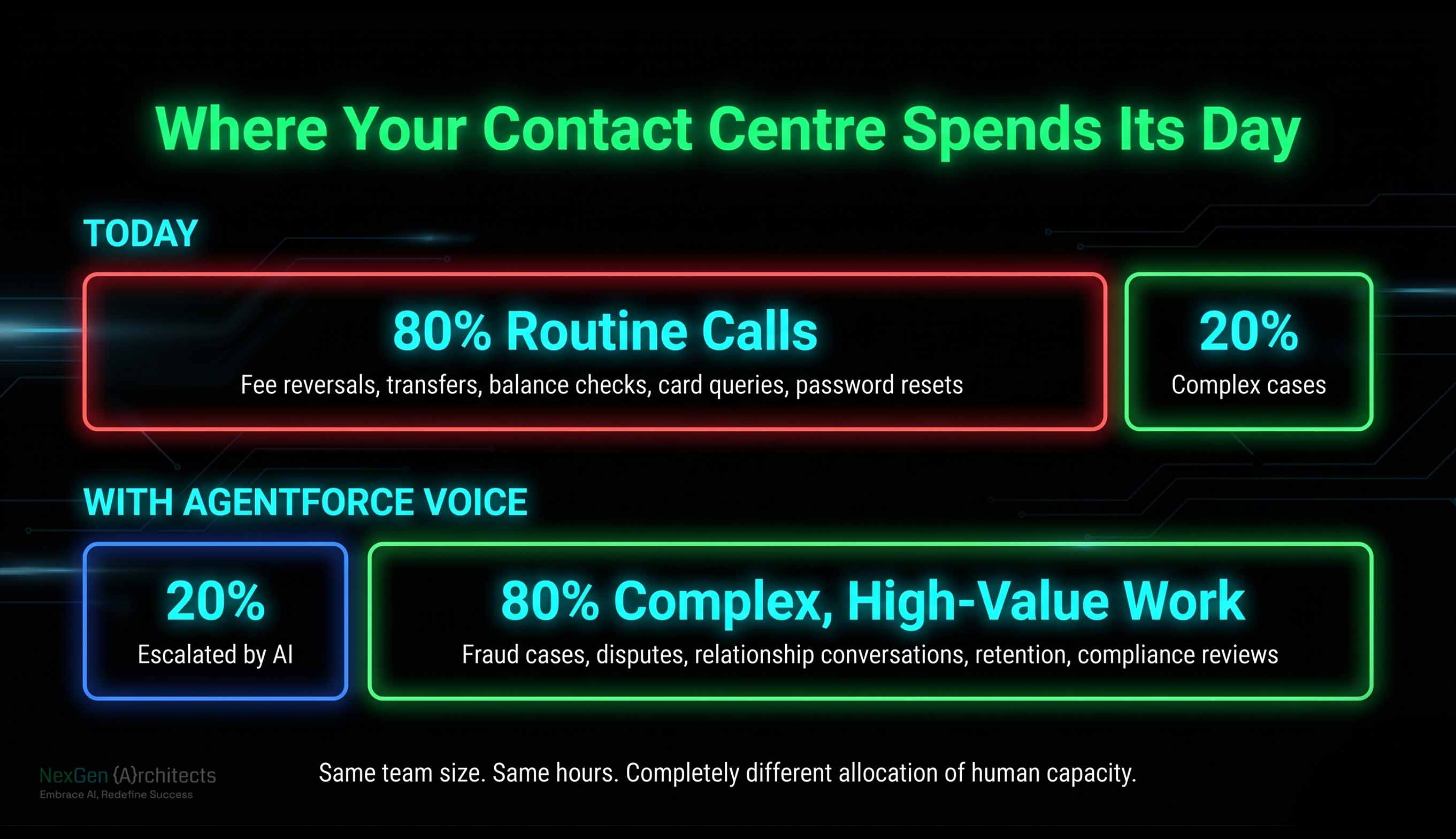
The operational impact of automating fee reversals and fund transfers shows up in three areas that COOs and contact centre directors measure daily.
Call volume absorption
Fee reversals and balance transfers are among the top five call drivers in most banks. Automating them through Agentforce Voice reduces the volume that reaches human agents significantly. Bank of America's AI assistant Erica surpassed 3 billion total client interactions by August 2025, averaging 58 million per month, proving that customers are comfortable resolving financial requests through AI when the experience is fast and reliable.
Agent capacity reallocation
Every routine call that Agentforce Voice resolves is a call that a human agent does not handle. That capacity redirects toward fraud investigations, complex disputes, relationship conversations, and retention calls where human judgment and empathy make the difference between keeping and losing a customer.
Compliance consistency
Human agents apply policies with slight variations depending on experience, training, and judgment in the moment. Agentforce Voice applies the same rules every time, logs every decision, and maintains a complete audit trail. Compliance officers get standardised evidence instead of inconsistent case notes.
What Agentforce Voice Does?
This is where the distinction matters for decision-makers evaluating the technology.
It replaces the repetitive, rule-based portion of contact centre work: verifying identity, checking policies, executing standard transactions, and logging outcomes. These steps are identical across thousands of calls and add no value when performed by a human.
It does not replace the conversations where a customer needs reassurance, where a regulation requires human interpretation, where the situation falls outside standard parameters, or where the relationship depends on empathy and judgment. Those calls still reach a human, but the human starts with full context instead of a blank screen.
The banks getting the most value from Agentforce Voice are the ones that drew this line clearly before deployment. They identified which call types are fully automatable, which need human oversight, and which must always reach a person. Then they built the escalation logic to match.
Explore Agentforce Voice for Banking
Identify the banking contact-centre workflows that are suitable for AI voice automation, define the required Salesforce and banking-system integrations, and establish the human escalation and governance model.
Talk to NexGen Architects about your Agentforce Voice use case.
Conclusion
Start with the two highest-volume, most repetitive call types in your contact centre. For most banks, that is fee reversals and fund transfers. Automate those end-to-end through Agentforce Voice. Measure the reduction in average handling time, the improvement in first-contact resolution, and the increase in agent availability for complex cases. Then expand to the next call type.
If your bank is trying to explore how Agentforce Voice fits into their Salesforce and contact centre architecture, then connect with the best team who builds these exact implementations.


